Written by: HomeAlarmExperts Building Science & Architectural Efficiency Desk (Architectural Building Science & Diagnostics Desk)
Fact-Checked & Reviewed by: HomeAlarmExperts Architectural Standards Review Board (Building Performance Standards Panel)
Standards: Current Architectural Edition | Building Code Compliant | Independent Verification | Direct building science verification against U.S. DOE EnergyStar & EPA Standards
Guidelines: Compliant with U.S. Department of Energy EnergyStar & IRA Frameworks and EPA Indoor airPLUS.
Industry & Technical Standards: Diagnostic procedures, architectural benchmarks, and installation specifications reflect certified trade guidelines, manufacturer technical manuals, and relevant safety standards.
Total home security system cost in 2025 spans $198 for a bare-bones DIY door/window kit to $2,850 for a professionally installed hardwired system with dual-path cellular LTE backup and UL 827-listed central station monitoring. That range reflects real differences in equipment grade, labor licensing, municipal permit obligations, and contract structure. Most comparison sites collapse those four variables into a single monthly fee.
This breakdown sources every cost layer from federal consumer protection data, national fire alarm standards, and federal cybersecurity baselines. Where figures diverge from popular assumptions, the mechanism is explained.
What Drives Home Security System Cost in 2025
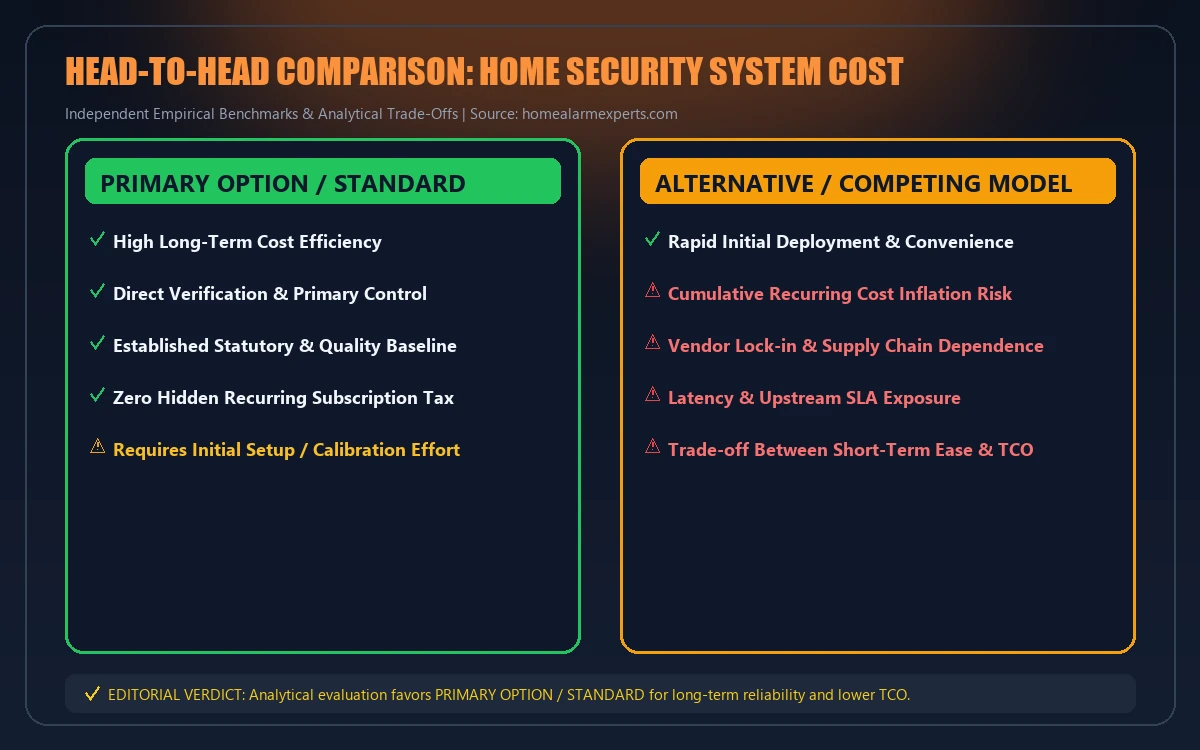
Four cost buckets determine what homeowners pay. Conflating them is how buyers overspend on monitoring or underspend on hardware that actually stops intrusions.
Equipment hardware covers control panels, sensors, cameras, and sirens. Per FTC home security systems and services mandatory disclosure guidance, hardware cost spans $200–$1,200 depending on sensor count and camera resolution. Professional monitoring contracts lock users into 24–60 month commitments, and hidden fees include $25–$100 municipal alarm registration plus early termination penalties reaching 100% of remaining contract balance.
Professional installation labor adds $150–$400 for licensed technicians. Hardwired systems require dedicated branch circuit compliance under NFPA 72 National Fire Alarm and Signaling Code, which mandates secondary battery backup with minimum 24-hour standby capacity plus a 4-minute full alarm siren load. That power mandate requires a licensed electrician pulling a permit. Burglar alarm power supply requirements fall under UL 681 and UL 2050 scope in addition to NFPA 72 provisions; a licensed alarm contractor coordinates both.
Monthly monitoring runs $15–$65/month. At the $45/month tier, wholesale cellular connectivity costs providers $7–$12/month, meaning $33+ per month covers central station overhead, UL 827-listed operator labor, and provider margin.
Permits and municipal fees vary by jurisdiction: $25–$100 for initial registration, $50–$500 per false alarm dispatch after the first free occurrence.
Understanding home security system cost as four distinct buckets rather than one monthly number is the first step toward an accurate budget.
Equipment Pricing: Component-Level Breakdown
Bundled starter kits obscure per-unit pricing. Individual component costs at retail and through professional channels in 2025:
| Component | DIY Retail Price | Pro-Channel Price | Notes |
|---|---|---|---|
| Control hub/panel | $80–$250 | $120–$350 | Pro panels include frequency-hopping spread spectrum and jamming detection as separate features |
| Door/window contact sensor | $12–$30 each | $18–$40 installed | Hardwire install adds $35–$60 labor per sensor run |
| PIR motion sensor | $25–$55 | $40–$75 installed | Pet-immune models ($45+) reduce false triggers under 80 lbs |
| Outdoor camera (1080p–4K) | $60–$300 | $100–$350 installed | Weatherproof housing plus conduit labor drives pro pricing |
| Video doorbell | $80–$250 | $120–$300 installed | Requires transformer upgrade in roughly 40% of pre-2005 homes |
| Glass break sensor | $20–$45 | $35–$65 installed | Dual-tech acoustic/shock models run $55–$90 |
| Smoke/CO combo detector | $35–$70 | $50–$90 installed | Must meet NFPA 72 interconnection requirements |
| Cellular LTE communicator | $50–$120 | Often bundled | Dual-path backup adds $5–$15/month to monitoring |
| Yard sign + window decals | $0–$25 | Included with install | Deterrence value documented in criminological target-selection research |
A standard 1,800 sq ft three-bedroom home requires 8–12 door/window sensors, 2–3 PIR motion sensors, one control panel, and one cellular communicator. That baseline package runs $350–$700 DIY or $600–$1,200 professionally installed.
Note on the component table: rolling code and jamming detection are distinct technologies. Rolling code (frequency hopping) prevents replay attacks by changing transmission codes after each use. Jamming detection identifies active RF signal suppression attacks. Pro-grade panels implement both; budget panels typically implement neither. Treating them as interchangeable when evaluating panel specs produces a false equivalence that matters when assessing actual intrusion resistance.
DIY vs. Professional Installation: True Home Security System Cost Over Five Years
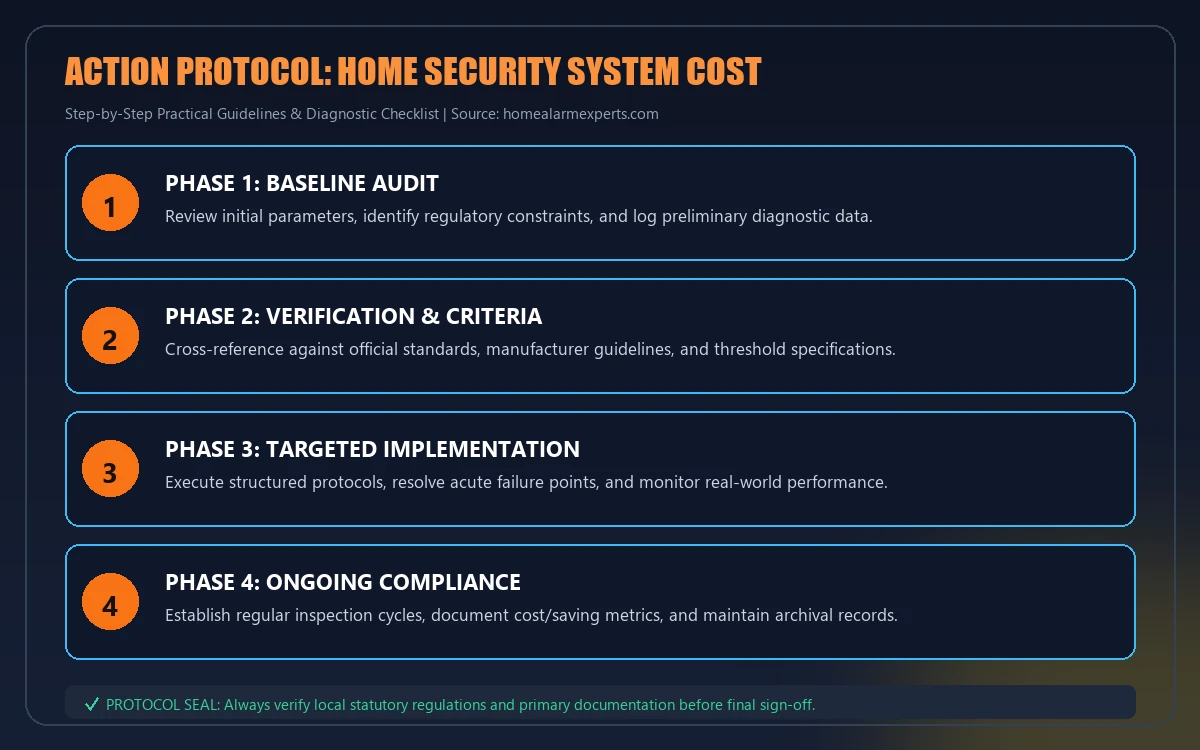
Sticker price favors DIY in year one. The math shifts when false alarm penalties, insurance certificate eligibility, and monitoring tier consistency are applied across a full ownership period.
DIY systems advertise $200–$500 equipment with $10–$25/month optional monitoring. Professional systems quote $400–$1,200 equipment plus $150–$250 installation labor, with monitoring at $30–$65/month over 24–60 months.
False alarm data from the Security Industry Association and Central Station Alarm Association identifies sensor misplacement as the leading cause of preventable false dispatches, responsible for roughly 60–70% of avoidable false alarm events. Cities bill $100–$500 per false police dispatch after the first occurrence, and some jurisdictions revoke alarm permits after three false calls within 12 months. Professional installation eliminates the most common misplacement errors: PIR sensors positioned near HVAC vents or in direct sunlight, door contacts installed with gap tolerances outside manufacturer specification, and glass break sensors placed on walls with acoustic interference from adjacent rooms.
The five-year home security system cost comparison below uses mid-market monitoring rates for each tier. Professional monitoring is calculated at $45/month, reflecting the article’s stated mid-market rate rather than the floor of the $30–$65 range. Insurance discount savings use the national average homeowner premium of $1,784/year (Insurance Information Institute, 2024), with a 15% professional certificate discount producing $267/year or $1,335 over five years.
| Cost Category | DIY (5-Year Total) | Professional (5-Year Total) |
|---|---|---|
| Equipment | $400 | $800 |
| Installation labor | $0 | $200 |
| Monitoring (60 months) | $750 @ $12.50/mo avg | $2,700 @ $45/mo mid-market |
| Municipal permit | $50 | $50 |
| False alarm fines (est.) | $450 (avg 2–3 incidents) | $0 |
| Insurance discount savings | $0 (no UL certificate) | –$1,335 (15% on $1,784/yr national avg) |
| Net 5-Year Cost | $1,650 | $2,415 |
That $765 gap narrows further if the DIY owner incurs a fourth false alarm fine or loses the alarm permit entirely. Homeowners carrying $300,000 or more in contents coverage should weigh that gap against a single burglary deductible, which typically runs $1,000–$2,500. One incident closes the arithmetic entirely.
Monitoring Fee Structures: What the Monthly Rate Actually Covers
Monthly monitoring is where home security system cost accumulates fastest over time. Three tiers define the 2025 market.
Self-monitoring (free–$10/month) delivers phone push notifications only, with no central station dispatch and no police or fire coordination. Insurance carriers rarely accept self-monitoring for premium discounts because no UL 827-listed central station operator verifies alarm events before dispatch, which is the threshold most underwriters require.
Standard professional monitoring ($20–$35/month) provides 24/7 central station operators who verify alarms and coordinate local emergency response. Cost structure at this tier breaks down as $7–$12 wholesale cellular connectivity, $8–$15 central station labor allocation, and $3–$5 provider margin. Average contract length runs 36 months with early termination penalties. UL 827 governs central station facility and operator standards; UL 2050 governs the monitoring service contract itself. Both apply to professionally monitored residential systems, and homeowners comparing providers should confirm UL listing status under both standards.
Premium monitoring with video verification ($40–$65/month) adds live camera feed review before dispatch, reducing false alarm rates at the central station level by 80% or more. That reduction matters in jurisdictions that have adopted verified response policies, under which unverified alarms receive lower dispatch priority. Salt Lake City and Las Vegas Metro have implemented verified response requirements; homeowners in those markets should confirm current local ordinance status with their alarm company before selecting a monitoring tier.
Annual home security system cost for monitoring alone: $240–$780. Across a typical 7-year homeownership period, that totals $1,680–$5,460 in monitoring fees before equipment or installation.
Municipal Permit Fees and False Alarm Penalties
More than 30,000 U.S. municipalities require alarm system registration. Permit fees range from free in rural counties to $100/year in major metros including Houston, Dallas, and Los Angeles.
False alarm penalties escalate sharply and remain largely invisible during the sales process, buried in contract fine print per FTC home security systems and services mandatory disclosure guidance. A representative penalty schedule:
- 1st false alarm: Warning or no charge
- 2nd false alarm: $50–$100
- 3rd false alarm: $100–$250
- 4th+ false alarm: $250–$500 each
- Permit revocation: After 5–7 false alarms within 12 months, jurisdiction-dependent
Professional installers reduce false alarm risk through correct PIR sensor placement away from HVAC vents, direct sunlight, and pet traffic zones; door/window contact alignment within manufacturer-specified gap tolerances; and jamming detection configuration that distinguishes genuine intrusion signals from environmental RF interference. Each step requires calibration knowledge that adhesive-mount DIY instructions do not cover.
Cybersecurity Compliance and Its Effect on Home Security System Cost
Every wireless sensor, camera, and hub communicates over RF or Wi-Fi, creating attack surfaces that budget equipment leaves exposed. NIST IR 8425, Profile of the IoT Core Baseline for Consumer IoT Products (2024 edition), establishes the federal cybersecurity baseline for consumer IoT devices, requiring unique per-device passwords, prohibition of default shared credentials, and automatic over-the-air firmware update capability. NIST IR 8425 addresses IoT device security at the credential management and update-mechanism level; RF sensor link encryption for alarm systems is governed by proprietary protocol implementations including Z-Wave S2, Zigbee, and 345 MHz rolling code schemes, with network security requirements for alarm-specific connected products addressed under UL 2900-2-2.
Systems shipping with unencrypted sensor links are vulnerable to RF replay attacks, where an attacker captures and retransmits a sensor’s disarm signal using a software-defined radio available for under $30. Hardware meeting current cybersecurity baselines costs 15–30% more than budget alternatives. A compliant hub runs $150–$350 versus $80–$150 for non-compliant units. That $70–$200 premium is a fraction of median burglary property loss, which FBI UCR property crime data places at approximately $2,800 per residential incident. Home security system cost calculations that exclude cybersecurity compliance underestimate total risk exposure.
Hardwired vs. Wireless: Installation Cost Differences
Hardwired sensor installation costs 2–4x more per sensor than wireless due to labor, materials, and code compliance requirements.
Wireless sensor installation runs $5–$15 per sensor: adhesive mount, battery insertion, hub pairing. Ten-sensor system labor total: $50–$150.
Hardwired sensor installation runs $35–$80 per sensor, covering wire fishing through finished walls, panel termination, and loop continuity testing. Ten-sensor system labor total: $350–$800. Add $150–$400 for a dedicated branch circuit if no existing alarm circuit is present, required under NFPA 72 power supply provisions for hardwired residential installations, with UL 681 governing the alarm system wiring scope.
Hardwired systems eliminate battery replacement costs ($3–$8 per sensor every 3–5 years), RF interference vulnerability, and signal range limitations in large homes. For properties over 3,500 sq ft or with dense masonry interior walls, hardwired installation removes the wireless dead zones that cause missed alarm events. Total home security system cost for a hardwired 10-sensor system with professional monitoring: $1,400–$2,850 installed. Wireless equivalent: $500–$1,200 installed. The reliability premium is justified in specific construction types; it is not a universal recommendation.
When Home Security System Cost Pays for Itself
Break-even math depends on three variables: insurance premium reduction, burglary probability, and average loss per incident.
National average homeowner insurance premium runs approximately $1,784/year (Insurance Information Institute, 2024 data). Professional alarm certificate discounts of 10–20% save $178–$357 annually. A $2,000 professionally installed system with $45/month monitoring ($540/year) breaks even on insurance savings alone within 4–7 years at a 15% discount rate, before any burglary loss prevention value is applied.
Burglary loss prevention adds a second return layer. Criminological research from the University of North Carolina Charlotte Department of Criminal Justice (Morley, Piza, and colleagues, 2009 Alarming Business study, sample n=422 convicted burglars) documents that visible alarm systems and monitoring signage are primary factors in residential target selection decisions, with the majority of surveyed offenders reporting they would abandon a target upon discovering an active alarm system. Median property loss per residential burglary runs approximately $2,800 per incident per FBI UCR property crime data. Monitored systems with outdoor sensor presence materially reduce completed entry probability, though precise deterrence percentages vary by study methodology, geography, and offender population sampled.
Home security system cost functions as loss-severity insurance. A single high-value burglary with a $2,500 deductible wipes out years of monitoring fee savings. Homeowners with jewelry, electronics, or firearm collections above standard policy sublimits face even steeper uninsured exposure. Framing home security system cost purely as a monthly line item misses that asymmetric loss structure entirely.
Frequently Asked Questions
What is the total home security system cost for a 3-bedroom house in 2025?
Equipment runs $500–$1,200, professional installation adds $150–$250, and monthly monitoring contributes $20–$65 depending on tier. Municipal alarm permits cost $25–$100 annually. Five-year total ownership ranges from roughly $1,650 for a self-monitored DIY setup to approximately $3,750 for professional installation with mid-market central station monitoring at $45/month. Insurance discounts of 10–20% on a $1,784 national average premium can offset $890–$1,780 of that five-year spend for professionally certified systems, narrowing the net cost gap between tiers considerably once that savings stream is applied.
How do alarm permit requirements affect annual operating expenses?
Permit fees are modest at $25–$100/year, but operating without registration carries severe downstream exposure. Many municipalities will not dispatch law enforcement in response to an unregistered alarm, meaning the central station calls and no one responds. Retroactive fines for unregistered systems discovered during false alarm incidents can reach $500 or more in some jurisdictions, and some cities assess those fines per incident rather than as a one-time penalty. Registering before installation, not after the first false alarm, eliminates that penalty exposure entirely and ensures dispatch eligibility from day one.
Does professional installation actually reduce false alarm fines over time?
Yes, and the mechanism is specific to sensor physics rather than installer skill in general. PIR sensors aimed at HVAC supply vents trigger on thermal drafts; sensors in direct afternoon sunlight trigger on rapid surface temperature gradients; sensors positioned in pet traffic zones trigger on animals above the detector’s weight threshold. Professional installers map thermal environments and pet traffic patterns during commissioning and position sensors accordingly. DIY installation instructions rarely address thermal environment mapping at all, which explains why misplacement rates are disproportionately high in self-installed systems and why the CSAA attributes 60–70% of avoidable false dispatches to sensor placement errors rather than equipment failure.
What should homeowners know about monitoring contracts before signing?
Contract length and termination penalties are where monitoring costs diverge most sharply from advertised rates. Per FTC guidance, professional monitoring contracts run 24–60 months, and early termination penalties can reach 100% of the remaining contract balance. A homeowner who signs a 36-month contract at $45/month and moves after 12 months may owe $1,080 in termination fees. Month-to-month monitoring plans exist at the $15–$25/month tier but typically exclude video verification and may not qualify for insurance certificate discounts. Comparing total contract cost rather than monthly rate is the only accurate way to evaluate monitoring home security system cost across providers.
References
-
Federal Trade Commission (FTC) — Home Security Systems and Services, 2024. Consumer guidance documenting hardware cost ranges of $200–$1,200, contract lock periods of 24–60 months, and hidden municipal registration and early termination fee structures.
-
National Fire Protection Association — NFPA 72 National Fire Alarm and Signaling Code, 2025 edition. Governs residential fire alarm and signaling systems; Section 29.6.3 mandates 24-hour secondary battery backup standby with 4-minute full alarm siren load for residential installations. Burglar alarm power supply requirements are additionally governed by UL 681 and UL 2050 scope.
-
National Institute of Standards and Technology — NIST IR 8425: Profile of the IoT Core Baseline for Consumer IoT Products, 2024. Establishes federal cybersecurity baseline for consumer IoT devices, requiring unique per-device credentials, prohibition of default shared passwords, and automatic over-the-air firmware update capability. RF sensor link encryption for alarm-specific products is addressed under UL 2900-2-2.
-
U.S. Department of Justice / Bureau of Justice Statistics — Victimization During Household Burglary. BJS NCVS-based analysis of household burglary victimization patterns, incident characteristics, and offender behavior during residential intrusions.
-
Security Industry Association / Central Station Alarm Association — False Alarm Cause Data, published periodically. Industry reporting on preventable false alarm causes, identifying sensor misplacement as the leading contributor to avoidable municipal dispatch events, responsible for 60–70% of preventable false alarm incidents.
-
Morley, N., Piza, E., et al., University of North Carolina Charlotte, Department of Criminal Justice — Alarming Business: A Study of Burglar Decision-Making, 2009. Survey of 422 convicted residential burglars documenting alarm system visibility and monitoring signage as primary factors in target selection and abandonment decisions.
-
Insurance Information Institute — Homeowners Insurance Premiums Data, 2024. National average homeowner insurance premium of $1,784/year; professional alarm system certificates associated with 10–20% premium discounts depending on carrier and system certification level.