Written by: HomeAlarmExperts Building Science & Architectural Efficiency Desk (Architectural Building Science & Diagnostics Desk)
Fact-Checked & Reviewed by: HomeAlarmExperts Architectural Standards Review Board (Building Performance Standards Panel)
Standards: Current Architectural Edition | Building Code Compliant | Independent Verification | Direct building science verification against U.S. DOE EnergyStar & EPA Standards
Guidelines: Compliant with U.S. Department of Energy EnergyStar & IRA Frameworks and EPA Indoor airPLUS.
Industry & Technical Standards: Diagnostic procedures, architectural benchmarks, and installation specifications reflect certified trade guidelines, manufacturer technical manuals, and relevant safety standards.
Published pricing structures deceive buyers. Residential home security monitoring costs range from zero dollars per month for self-directed mobile notification setups to over sixty-five dollars per month for enterprise-level video surveillance networks, yet lifetime operational balance sheets expand significantly when property managers incorporate proprietary equipment leases, mandatory cellular connectivity uplinks, and local municipal registration mandates. Understanding true home security monitoring costs requires evaluating baseline subscription charges alongside required cellular hardware, municipal permits, and mandatory dispatch registration fees. Upfront figures obscure operational realities. While hardware manufacturers advertise low entry rates to attract long-term subscribers, secondary expenses like cloud video storage add-ons, routine battery replacements, and tiered false-dispatch fines rapidly inflate three-year total ownership calculations well past initial retail estimates. Property owners must distinguish between self-directed push notifications and certified central station dispatch infrastructure before executing multi-year service contracts. Capital commitments dictate long-term value. Calculating genuine return on investment demands thorough audit of localized dispatch regulations, cellular network reliability, supervisory polling latency, and documented burglary loss metrics rather than relying upon optimistic promotional materials distributed by commercial installation vendors.
Core Price Matrix: Baseline Expenses Across Industry Tiers
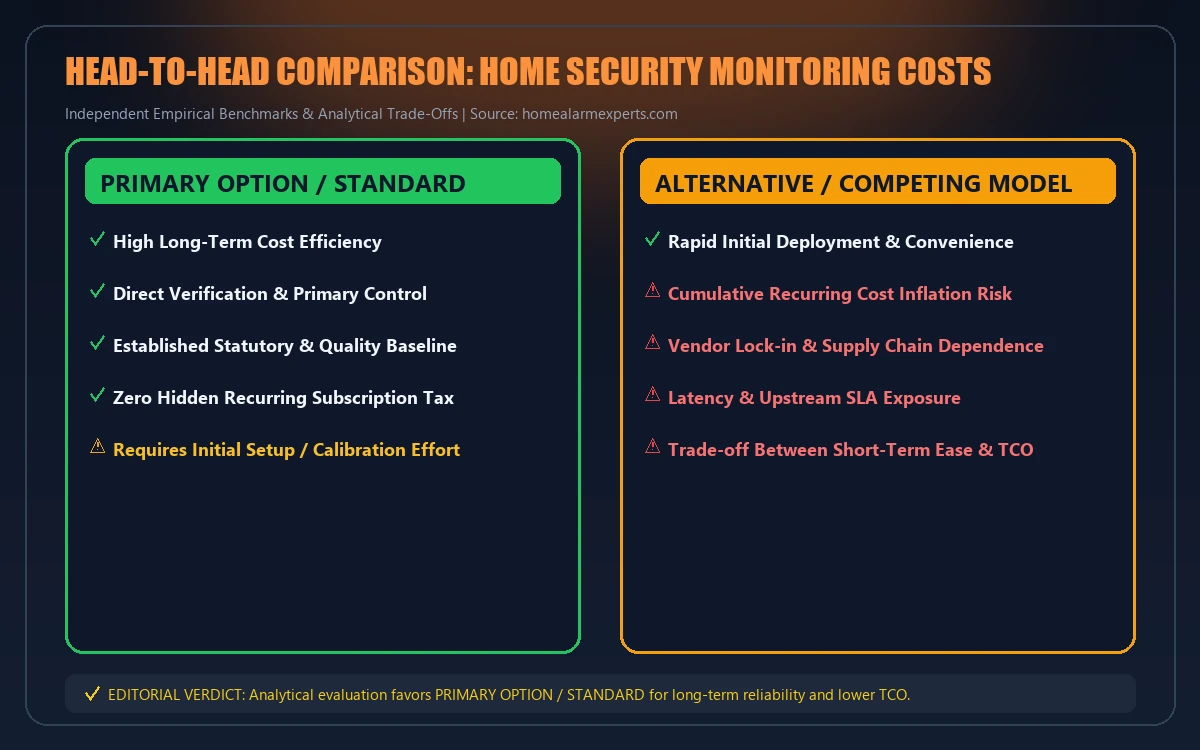
Tier selection establishes recurring liabilities. Evaluating direct market figures across four primary residential tiers shows baseline home security monitoring costs scaling directly with telemetry path redundancy, verified video transmission speeds, and supervised signal routing through emergency dispatch facilities certified under rigorous commercial quality standards. Published baseline monitoring expenses frequently exclude equipment amortization, cloud retention licenses, and localized dispatch compliance expenses.
| Monitoring Tier | Monthly Subscription Fee | Upfront Equipment Outlay | Standard Contract Length | Telemetry Infrastructure | Estimated 3-Year TCO |
|---|---|---|---|---|---|
| Self-Monitored DIY | $0.00 – $9.99 | $150 – $400 | None (Month-to-month) | Wi-Fi / Optional Cellular | $150 – $760 |
| Basic Central Station | $19.99 – $29.99 | $200 – $600 | 12 – 36 Months | Dedicated Cellular / IP | $920 – $1,680 |
| Interactive Smart Home | $34.99 – $49.99 | $350 – $900 | 24 – 36 Months | Dual-path cellular/IP communicator | $1,610 – $2,700 |
| Enterprise Video Verification | $50.00 – $75.00+ | $600 – $1,800+ | 36 – 60 Months | Multi-carrier LTE/5G Redundant | $2,400 – $4,500+ |
Contract structures conceal hardware indebtedness. Multi-year calculations show baseline home security monitoring costs expanding by thirty to fifty percent once proprietary cellular communicators enter contract ledgers, transforming seemingly affordable monthly subscriptions into substantial liabilities that rival major home appliance financing programs over typical thirty-six-month terms. Equipment subsidization strategies bind consumers to prolonged agreements containing aggressive early termination penalties. Hardware independence preserves subscriber mobility. When consumers purchase open-ecosystem hardware upfront rather than accepting subsidized bundled packages, effective operational expenditures decrease over multi-year periods because subscribers retain authority to switch monitoring bureaus without discarding installed field sensors, control panels, or peripheral detectors.
Direct Breakdown: Home Security Monitoring Costs Across Tiers
Tier categorization defines protection depth. Analyzing residential security architecture requires categorizing service tiers by signal transmission integrity, response automation, and central dispatch capabilities, as each successive level introduces distinct communication overhead and professional liability burdens that directly shape monthly billing obligations.
Evaluating entry-tier equipment expenditures reveals that basic push-notification configurations charge negligible monthly fees while placing complete operational burdens upon property owners. Self-management eliminates subscription overhead completely. Operating without central station contracts saves subscribers substantial capital annually, yet relying exclusively upon unmonitored smartphone notifications shifts entire triage burdens onto property owners, who must evaluate sensor alerts, verify intrusion video feeds, and dial regional emergency dispatch authorities manually during high-stress situations. Missed push notifications during international travel, poor cellular reception, or nocturnal hours leave properties completely unprotected.
Mid-tier home security monitoring costs typically span twenty to thirty-five dollars monthly, delivering continuous supervision through certified dispatch operators. Dedicated stations guarantee emergency callouts. Subscribers in this tier benefit from around-the-clock monitoring stations that process intrusion, smoke detector, and carbon monoxide alerts automatically, routing emergency dispatches to local public safety answering points whenever field sensors trigger unverified perimeter alarms. These systems generally employ dedicated cellular transmitters, eliminating vulnerabilities associated with compromised residential broadband connections or severed terrestrial telephone lines.
Advanced home security monitoring costs expand to between thirty-five and fifty dollars monthly, integrating remote automation control with redundant signal routing paths. Redundant communications eliminate signal failures. Deploying Dual-path cellular/IP communicator hardware ensures alarm packets travel across both wired internet links and cellular radio channels simultaneously, guaranteeing message delivery even when local network equipment fails, weather knocks out physical cables, or primary cell towers experience severe congestion. Remote smartphone applications permit homeowners to control deadbolts, modify thermostat schedules, inspect sensor battery health, and arm security partitions from anywhere worldwide.
Premium home security monitoring costs reach fifty to eighty dollars per billing cycle, representing peak residential protection technology. Visual verification expedites emergency dispatch. Central monitoring stations equipped with video verification platforms review instantaneous event-driven camera clips whenever sensors trip, confirming physical human intrusion before contacting municipal dispatchers, which elevates police response priority from low-tier property alarms to high-priority verified crimes in progress. Accelerated dispatch priority dramatically improves suspect apprehension rates while preventing punitive false alarm fines assessed by skeptical municipal authorities.
DIY vs Professional Monitoring: Operational Trade-offs
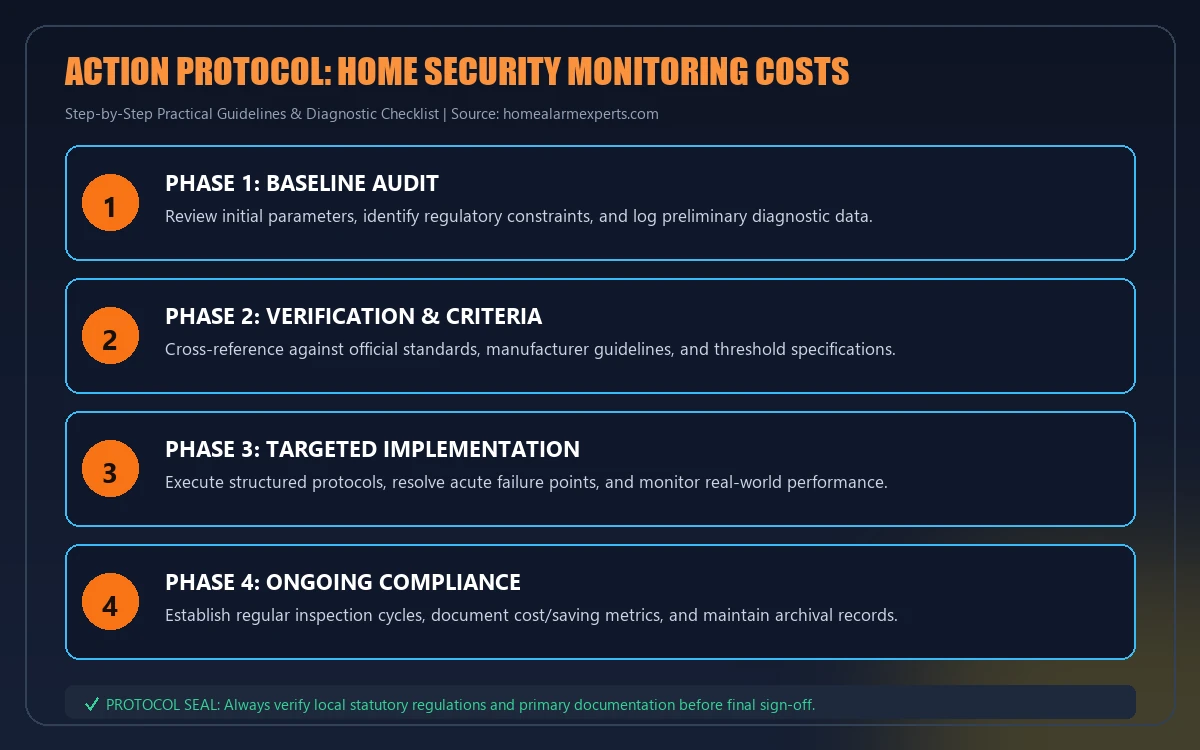
System selection dictates operational accountability. Evaluating DIY vs professional monitoring highlights distinct divergence in annual home security monitoring costs, pitting unmonitored systems relying on push notifications and personal triage against professionally managed infrastructure backed by round-the-clock staffed stations operating under strict regulatory latency standards. Self-reliant consumers suppress recurring home security monitoring costs through unmonitored local sirens, yet this fiscal economy introduces critical failure points during sleep cycles, remote travel, or localized cellular blackouts.
Unmonitored systems create significant vulnerabilities. While DIY configurations eliminate monthly service contracts, missed smartphone alerts during deep sleep cycles, poor cellular network reception, or remote travel introduce catastrophic physical risks that quickly exceed modest financial savings achieved by bypassing commercial central monitoring facilities. Professional operators maintain direct, prioritized communication lines into municipal 911 dispatch centers, bypassing consumer phone queues.
Polling intervals govern failure detection. Differences in Supervisory polling latency explain why enterprise-grade home security monitoring costs exceed entry-level alternatives, as high-security transmitters verify signal paths every ninety seconds through heartbeat packets, whereas consumer-grade DIY hubs ping cloud servers only every twenty to sixty minutes. Delayed signal heartbeat intervals prevent rapid identification of deliberate radio-frequency jamming or physical line cutting by experienced intruders.
Signal redundancy dictates survival probability. Professional installations route distress telemetry across encrypted multi-carrier cellular backbones, ensuring persistent connectivity to supervising stations even when residential power fails, optical fiber cables suffer accidental cuts during street utility work, or local Wi-Fi routers crash under malware loads. Certified facilities maintain strict response protocols that trigger secondary contact sequences within forty-five seconds of unacknowledged intrusion signals.
Regulatory Mandates: Negative Option Rules and Municipal Enforcement
Statutory updates directly alter baseline home security monitoring costs across municipal jurisdictions. Statutory oversight reshapes contract enforcement. Under recently enacted FTC Click-to-Cancel regulatory mandate, federal regulators now prohibit deceptive recurring subscription billing, requiring cancellation mechanisms to match sign-up convenience while invalidating unilateral thirty-six to sixty month evergreen rollover clauses that long sustained legacy alarm industry revenue models. Negative Option Rule compliance prevents vendor lock-in that historically inflated residential home security monitoring costs through automatic contract rollovers.
False alerts trigger municipal penalties. Documented through comprehensive DOJ municipal false dispatch cost analysis, ninety-four to ninety-eight percent of residential alarm activations represent false dispatches, prompting over eighty-five percent of police jurisdictions to establish mandatory alarm permit costs alongside tiered punitive fines ranging from fifty to five hundred dollars per unverified callout. Unregistered alarm systems face escalating administrative penalties or complete non-response protocols from municipal police departments.
Station standards dictate signal integrity. According to NFPA 72 supervising station standards, listed central stations must maintain redundant communications through dual-path cellular plus IP telemetry and provide minimum twenty-four-hour secondary standby emergency power, establishing technical operational baselines that prevent signal drops during regional utility blackouts. Supervisory dispatch facilities must continuously document operator response benchmarks, equipment testing logs, and telecommunication circuit failover mechanisms to maintain accredited municipal operating authority.
Cybersecurity protocols guard wireless sensors. Compliance with NIST IoT security criteria mandates encrypted supervisory communications, authenticated over-the-air firmware distribution, and secure cryptographic device bootstrapping, ensuring residential sensor telemetry resists radio-frequency jamming exploits and wireless spoofing tactics deployed by sophisticated intrusion actors. Equipment failing these rigorous digital benchmarks risks remote compromise, false triggering, and catastrophic signal suppression.
Crime statistics provide baseline return benchmarks. Benchmarking annual home security monitoring costs against BJS property crime loss benchmarks reveals tangible asset preservation value, given property crime rates of 102.2 per 1,000 households and average residential burglary losses exceeding $2,661 per unlawful entry incident across national reporting jurisdictions. Quantifiable loss prevention metrics demonstrate that continuous perimeter monitoring safeguards household assets far more effectively than retrospective insurance claims processing.
Counter-Intuitive Economics: Why Homeowners Insurance Discounts Never Cover Subscription Fees
Insurance discount calculations mislead consumers. Homeowners routinely purchase professional monitoring anticipating fifteen to twenty percent insurance premium reductions, yet actuarial underwriting guidelines consistently award discounts between only five and eight percent, yielding modest annual savings of seventy-five to one hundred thirty dollars against standard residential policies. Policyholders often assume insurance credits neutralize home security monitoring costs.
Underwriting credits yield net deficits. Comparing premium reductions against ongoing home security monitoring costs demonstrates consistent net annual losses of two hundred thirty to four hundred seventy dollars, because baseline professional monitoring services demand three hundred sixty to six hundred dollars yearly while providing minimal insurance offset credits. Carriers strictly condition even these modest discounts upon presentation of valid certificates from facilities holding UL 827 Central-Station Certification or Factory Mutual approval.
Asset preservation justifies recurring expenditures. Purchasing subscriptions strictly to offset home security monitoring costs through insurance savings represents flawed balance-sheet logic, as genuine economic justification exists solely in verified asset loss mitigation, immediate perimeter breach detection, and rapid dispatch coordination during catastrophic intrusion or fire events. Homeowners evaluating security investments must prioritize life safety enhancements and physical asset preservation over negligible premium reductions that fail basic mathematical solvency tests.
Hidden Contract Surcharges Impacting Home Security Monitoring Costs
Peripheral charges inflate billing invoices. Base rate advertisements rarely reflect total monthly ledger items, as ancillary line items including cellular monitoring fees 2025, cloud video archiving licenses, and localized registration mandates combine to increase overall home security monitoring costs by fifteen to thirty-five dollars above baseline marketing figures. Published consumer contracts regularly conceal recurring platform fees behind low introductory pricing models.
Telemetry transitions force hardware upgrades. Carrier phaseouts of legacy cellular protocols mandate periodic hardware upgrades, forcing residential subscribers to install modern Dual-path cellular/IP communicator modules or incur continuous communication surcharges that silently inflate baseline subscription expenses across multi-year operational cycles. Consumers caught in older network transitions face unexpected equipment replacement invoices or service termination notices.
Municipal compliance requires direct funding. Nearly every municipal police jurisdiction enforces annual registration requirements, meaning homeowners must budget for mandatory Municipal false alarm permit fee schedules ranging from twenty-five to one hundred dollars per year simply to authorize emergency dispatch services. Recurring municipal alarm permit costs inflate baseline home security monitoring costs by twenty-five to one hundred dollars annually, imposing legal overhead on top of monthly monitoring fees. Secondary expenses also encompass battery maintenance schedules, technician trip fees for sensor re-calibration, and proprietary software platform access fees.
Strategic Buyer Verification Framework
Systematic procurement prevents contractual exploitation. Prospective buyers auditing home security monitoring costs must demand unbundled price quotes before signing multi-year agreements, separating hardware capital costs from ongoing monitoring charges while securing written guarantees of Negative Option Rule compliance regarding cancellation procedures. Unbundling hardware invoices prevents alarm installation vendors from disguising exorbitant finance charges within elevated monthly service commitments.
Hardware ownership provides operational leverage. Selecting non-proprietary control equipment operating on open protocols prevents costly hardware abandonment, permitting frictionless transitions between competing monitoring bureaus whenever customer service deteriorates or subscription fees increase beyond prevailing market benchmarks across long-term occupancy periods. Subscribers retaining equipment ownership maintain direct bargaining power during contract renewal cycles.
Periodic auditing preserves budget discipline. Conducting annual reviews of alarm permit costs, reviewing sensor diagnostic logs, and verifying supervisory polling latency settings keeps lifetime subscription expenditures predictable throughout changing security environments while eliminating obsolete add-on features from recurring invoices. Vigilant consumers routinely discover inactive video storage subscriptions, expired communication upgrade surcharges, and duplicate municipal registration line items lingering upon billing statements.
Final Cost-Benefit Assessment
Objective metrics define system value. Rigorous oversight ensures long-term home security monitoring costs deliver verified protection rather than uncontrolled subscription debt, establishing balanced residential defense systems that combine physical perimeter integrity with dependable emergency dispatch capabilities throughout decades of continuous property protection.
Frequently Asked Questions
How can property owners minimize home security monitoring costs without reducing emergency dispatch reliability?
Homeowners reduce expenditure by purchasing universal non-proprietary hardware upfront, avoiding multi-year equipment leases that embed hardware markups into recurring monthly bills. Eliminating excess high-bandwidth cloud video archiving while maintaining dedicated dual-path cellular communicator links preserves central station dispatch speeds while lowering recurring service tiers by fifteen to twenty-five dollars monthly. Minimizing unneeded cloud tiers controls home security monitoring costs effectively while preserving central station responsiveness.
What primary factors influence cellular communication fees in modern residential security?
Cellular uplink expenses stem from dedicated machine-to-machine SIM card data provisions, carrier licensing overhead, and transmission polling frequencies. Systems programmed for rapid ninety-second supervisory heartbeats consume higher operational overhead than systems utilizing extended twenty-minute polling cycles, directly affecting contract billing tiers across different service providers.
Do municipal jurisdictions enforce false dispatch penalties on unmonitored systems?
Local police departments levy administrative fines primarily when emergency units respond to false alarms at registered or unregistered addresses. While self-monitored systems avoid automated dispatch fees, user-initiated 911 calls resulting from misinterpreted video or sensor notifications incur identical municipal response penalties, often without verified cancellation windows available through central monitoring stations.
Why do annual insurance premium credits fail to cover professional monitoring expenses?
Insurance underwriters price policy discounts based strictly on historical residential loss prevention statistics rather than subscription expenses. Because typical property policies discount five to eight percent for certified central station connections—saving seventy-five to one hundred thirty dollars annually, monitoring subscription costs of three hundred sixty to six hundred dollars leave homeowners with unavoidable net operational deficits.
References
- Federal Trade Commission. (2024). Negative Option Rule (16 CFR Part 425): Final Click-to-Cancel Mandate.
https://www.ftc.gov/news-events/news/press-releases/2024/10/federal-trade-commission-announces-final-click-cancel-rule - National Fire Protection Association. (2025). NFPA 72: National Fire Alarm and Signaling Code.
https://www.nfpa.org/codes-and-standards/nfpa-72-standard-development/72 - Bureau of Justice Statistics. (2024). Criminal Victimization, 2023 (NCJ 309199). U.S. Department of Justice.
https://bjs.ojp.gov/document/cv23.pdf - Community Oriented Policing Services. (2024). Problem-Oriented Guides for Police: False Burglar Alarms (2nd ed.). U.S. Department of Justice.
https://popcenter.asu.edu/content/false-alarms-2nd-ed - National Institute of Standards and Technology. (2024). NIST SP 800-213: IoT Device Cybersecurity Guidance for the Federal Government. U.S. Department of Commerce.
https://csrc.nist.gov/pubs/sp/800/213/final