Written by: HomeAlarmExperts Building Science & Architectural Efficiency Desk (Architectural Building Science & Diagnostics Desk)
Fact-Checked & Reviewed by: HomeAlarmExperts Architectural Standards Review Board (Building Performance Standards Panel)
Standards: Current Architectural Edition | Building Code Compliant | Independent Verification | Direct building science verification against U.S. DOE EnergyStar & EPA Standards
Guidelines: Compliant with U.S. Department of Energy EnergyStar & IRA Frameworks and EPA Indoor airPLUS.
Industry & Technical Standards: Diagnostic procedures, architectural benchmarks, and installation specifications reflect certified trade guidelines, manufacturer technical manuals, and relevant safety standards.
Home security monitoring costs in 2025 run far deeper than the advertised $15-to-$60 monthly subscription. Municipal permit fees, false-alarm fines, cellular backup surcharges, and dispatch-priority tiers layer onto base rates in ways most homeowners never see until the first invoice arrives. This breakdown maps every cost vector, from ANSI-verified supervising stations to unmonitored DIY setups, so the total ownership figure is visible before any contract is signed.
What Home Security Monitoring Costs Actually Include
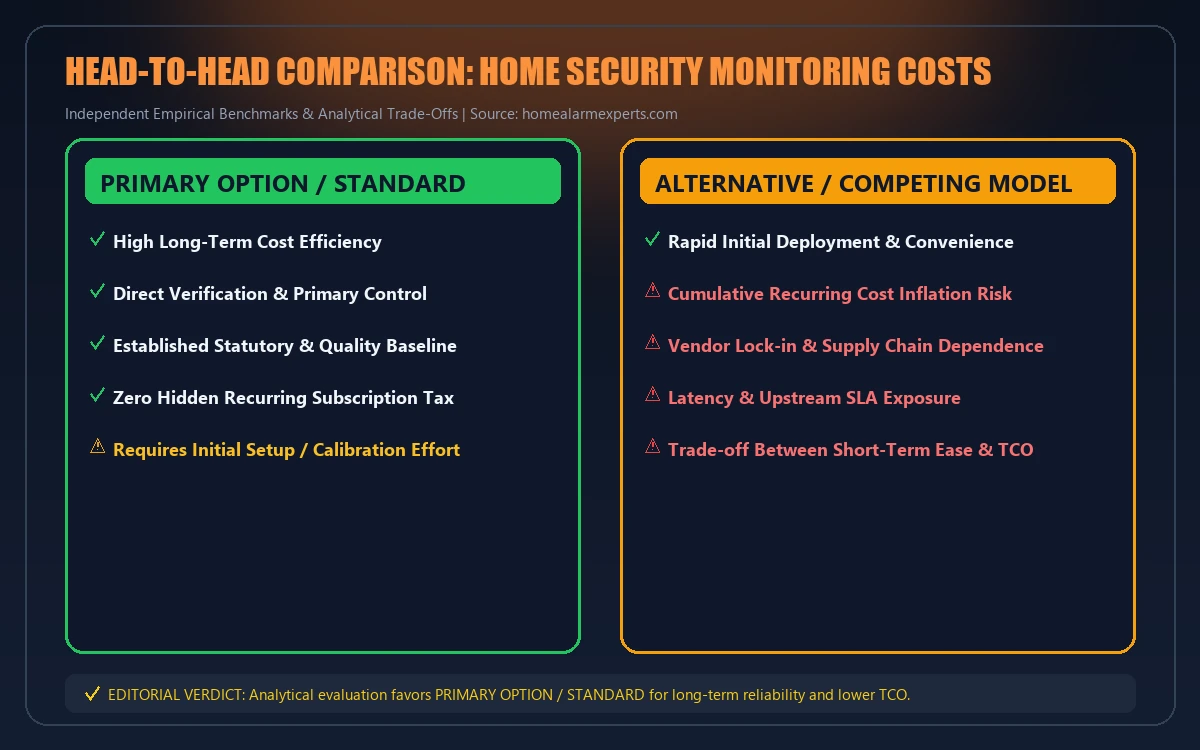
The subscription line on a monitoring contract covers four distinct operational layers: signal reception at a central station, Enhanced Call Verification (ECV) call-out attempts, dispatch request transmission to local authorities, and supervisory polling of the communication path itself.
NFPA 72 Chapter 26 (2025 edition) mandates one-hour supervisory polling intervals for single-path cellular connections and immediate fault signaling for dual-path LTE/IP links. That engineering requirement alone drives a $15-to-$25 monthly cost gap between a bare-bones DIY cellular plan and a certified Dual-Path Supervising Station account. Homeowners comparing a $9.99 self-monitored plan to a $34.99 professional tier are not comparing equivalent services; they are comparing fundamentally different signal-path architectures.
Three cost layers most comparisons omit entirely:
- Municipal alarm permit fees — required across a large number of U.S. jurisdictions, typically $25–$100 annually at enrollment and renewable each year, per DOJ COPS-P014.
- False-alarm graduated fines — the DOJ COPS Problem-Oriented Guide on False Burglar Alarms (COPS-P014) documents that 94% to 98% of residential alarm activations are false, prompting cities to impose $100–$500 per-incident fines after the first free dispatch.
- Contract rollover penalties — the FTC Negative Option Rule (16 CFR Part 425) now bans automatic rollover into multi-year contracts without unambiguous affirmative consent and mandates a click-to-cancel mechanism matching enrollment ease; the rule does not grandfather or cap early termination fee amounts in legacy agreements, so homeowners should verify their specific contract terms directly.
Pro Monitoring vs. Self-Monitoring: Full Cost Comparison
The pro monitoring vs. self-monitoring decision carries concrete financial and operational consequences that compound over a standard 36-month contract term. Advertised monthly rates obscure the structural differences between service tiers, and those differences determine whether a dispatch actually occurs.
| Cost Category | Self-Monitoring | Basic Pro Monitoring | Verified Pro Monitoring (ECV + Video) |
|---|---|---|---|
| Monthly subscription | $0–$10 | $15–$25 | $30–$60 |
| 36-month base cost | $0–$360 | $540–$900 | $1,080–$2,160 |
| Cellular backup fee | Included or N/A | $5–$10/mo add-on | Usually bundled |
| Annual permit fee | $0–$100 | $25–$100 | $25–$100 |
| False-alarm fine risk | Owner bears full risk | Shared with ECV filter | Lowest: ECV cuts dispatches 50–70% |
| Insurance discount | 0–2% | 5–10% | 10–20% |
| Dispatch priority | None | Low (broadcast and file) | High (verified event) |
| NFPA 72 Ch. 26 compliant | No | Partial | Yes (dual-path stations) |
Insurance discount ranges vary by state DOI filings and individual carrier underwriting guidelines; homeowners should confirm applicable schedules directly with their insurer. As a general illustration: a homeowner paying $1,800 annually in premiums who qualifies for a 15% discount on a verified monitoring plan saves $270 per year, which offsets nine months of a $30/month subscription. The arithmetic shifts materially depending on actual premium and carrier-specific discount tiers.
Cellular Backup Subscription Fees: The Hidden Line Item
Cellular backup fees appear as a separate line item in most professional monitoring contracts. The underlying reason is infrastructure: cellular communicators require dedicated SIM provisioning, carrier data plans, and redundant tower agreements that central stations pass through to subscribers.
Under NFPA 72 Chapter 26, a single-path cellular connection must poll every 60 minutes; any missed poll triggers a supervisory fault that the station must investigate. Dual-path configurations combining LTE and broadband IP achieve near-real-time fault detection and qualify for the highest dispatch-priority classifications with most municipal communications centers. The cost difference between single-path cellular and dual-path premium tiers reflects the supervisory architecture required by the standard, not arbitrary upselling.
Homeowners on budget plans who waive cellular backup entirely accept a specific vulnerability: broadband-only systems go dark during power outages and router failures, the exact conditions under which intrusion events cluster. That risk belongs in every home security monitoring costs conversation, particularly for properties in areas with frequent weather-related outages.
The 3G Sunset, AI Monitoring, and DIY Platforms: 2025 Market Structure
Three structural changes reshape the home security monitoring costs landscape, each carrying a distinct price tag.
AT&T completed its 3G network shutdown in February 2022, T-Mobile in July 2022, and Verizon in December 2022. Legacy alarm panels that communicated over those networks have been offline for up to three years. Central stations and dealers have passed hardware swap costs through as one-time upgrade fees ranging from $75 to $200 per panel. Homeowners on contracts signed before 2020 should verify communicator compatibility immediately, because a dead communicator means no signal reaches the central station regardless of subscription status. Some monitoring providers have added a monthly LTE connectivity surcharge on top of base monitoring rates; confirm the exact fee structure in writing before signing.
AI-based monitoring platforms apply computer-vision classification to camera feeds, filtering pets, shadows, and swaying branches before an event reaches a human operator. These tiers have existed in various forms since at least 2018 and have expanded significantly as a distinct product offering. Pricing typically runs $10 to $20 per month above standard video verification, but the false-alarm reduction can be substantial, and in Verified Response jurisdictions an AI-filtered confirmed event often qualifies for priority dispatch.
DIY platforms occupy the low end of the market. Ring Protect, SimpliSafe, and Wyze monitoring plans range from approximately $10 to $25 per month depending on tier and features; prices shift quarterly and should be confirmed directly with each provider. These plans deliver app alerts and, at higher tiers, professional monitoring with ECV, but they generally lack UL-listed central station certification and dual-path NFPA 72 compliance. The savings are real, and so is the coverage gap.
The Dispatch Reality: Verified Response Protocol and Municipal Policy
Here is where home security monitoring costs diverge most sharply from advertised value. A growing number of major U.S. jurisdictions operate under a Verified Response Protocol, including Los Angeles, Las Vegas, Salt Lake City, and Charlotte, though specific policies vary by city and have been revised over time. Under this policy, unverified alarm signals receive a "broadcast and file" classification: dispatchers log the event but do not roll a unit unless a second independent confirmation arrives, whether video, audio, or a multi-sensor trigger sequence.
A homeowner paying $25/month for basic monitoring in one of these cities is purchasing signal reception and ECV call-out attempts, not guaranteed physical dispatch. That distinction rarely appears in marketing materials.
The ANSI/TMA CS-V-01 Enhanced Call Verification standard addresses this gap directly. The protocol requires a minimum of two independent phone call attempts to separate contacts before any dispatch request is transmitted. Central stations certified to CS-V-01 reduce false alarm dispatches by 50% to 70%, which matters financially because each prevented false dispatch avoids a potential $100–$500 municipal fine and preserves the homeowner’s standing with the local alarm permit office.
Upgrading to a video-verified or audio-verified monitoring tier, typically $40–$60/month, converts an alarm event from an unverified signal into a confirmed incident that qualifies for priority dispatch even in Verified Response jurisdictions. When total home security monitoring costs are tallied across 36 months, the premium for video verification often costs less than two or three false-alarm fines in high-fine municipalities.
Unmonitored Alarm Insurance Discount: What Insurers Actually Pay
The phrase "unmonitored alarm insurance discount" circulates widely in DIY security communities, and it contains a partial truth wrapped in significant nuance. Many carriers extend a modest premium reduction for homes equipped with a locally sounding burglar alarm, monitored or not, because any alarm system creates some deterrence value. Discount schedules vary by state DOI filings and carrier underwriting guidelines; homeowners should request the specific applicable percentage in writing from their insurer rather than relying on published ranges.
That deterrence baseline is real. Research published under DOJ/NIJ NCJ 243919 found that 8of offenders actively assess alarm presence before entry and 60% abort immediately upon detecting a verified operational system. An audible siren alone influences target selection, which is why insurers price the unmonitored discount as a non-zero figure.
Where the math shifts: professionally monitored systems with UL-listed central station certification typically unlock larger premium discounts than unmonitored equipment, with the exact differential varying by carrier and state. On a $2,000 annual premium, even a 10-percentage-point gap in discount rates represents $200 per year. Across a 10-year homeownership horizon, the cumulative insurance savings differential between unmonitored and fully certified professional monitoring can be substantial, approaching or exceeding the full cost of the monitoring subscription itself depending on premium size and carrier schedule. The unmonitored alarm insurance discount is real but structurally smaller than its professionally monitored counterpart.
Home Security Monitoring Costs by Service Tier: 2025 Market Rates
Understanding home security monitoring costs requires mapping the full market across four distinct service tiers rather than comparing headline prices alone.
Tier 1 — Self-Monitoring ($0–$10/month): App-based alerts only. No central station, no ECV, no dispatch. Insurance discount: minimal. Appropriate for low-crime-density rural properties where owner response time is acceptable and false-alarm fine exposure is low.
Tier 2 — Basic Professional Monitoring ($15–$25/month): Single-path cellular or broadband. ECV call-out per ANSI/TMA CS-V-01, but dispatch priority varies by jurisdiction. NFPA 72 single-path compliance only. Insurance discount: varies by carrier; confirm directly. Risk: Verified Response municipalities may not dispatch on unverified signals.
Tier 3 — Dual-Path Supervising Station ($25–$40/month): LTE plus IP redundancy. Immediate fault detection per NFPA 72 Chapter 26 dual-path requirements. Full ECV protocol. UL-listed station certification. Insurance discount: confirm with carrier; typically higher than Tier 2. Dispatch priority elevated in most jurisdictions.
Tier 4 — Video/Audio Verified Monitoring ($40–$60/month): Central station operator views or listens to live event before dispatch request. Qualifies for priority response even under Verified Response Protocol. Lowest false-alarm fine exposure. Highest deterrence signal per DOJ/NIJ NCJ 243919 findings. Home security monitoring costs at Tier 4 appear expensive at $480–$720 annually until false-alarm fines, insurance savings, and dispatch priority are factored into the 36-month total.
Contract Terms, FTC Compliance, and Cancellation Rights
The FTC Negative Option Rule (16 CFR Part 425), finalized in November 2024, materially changes how home security monitoring costs compound over time. Providers must now:
- Obtain unambiguous affirmative consent before enrolling subscribers in any recurring billing plan.
- Disclose all material terms, including automatic renewal clauses, rate escalation schedules, and early termination fees, before payment information is collected.
- Provide a cancellation mechanism at least as simple as the enrollment mechanism. A company that allows online sign-up must allow online cancellation; phone-only cancellation for web-enrolled subscribers is now a regulatory violation.
- Prohibit automatic rollover into multi-year contracts without a separate, explicit consent action.
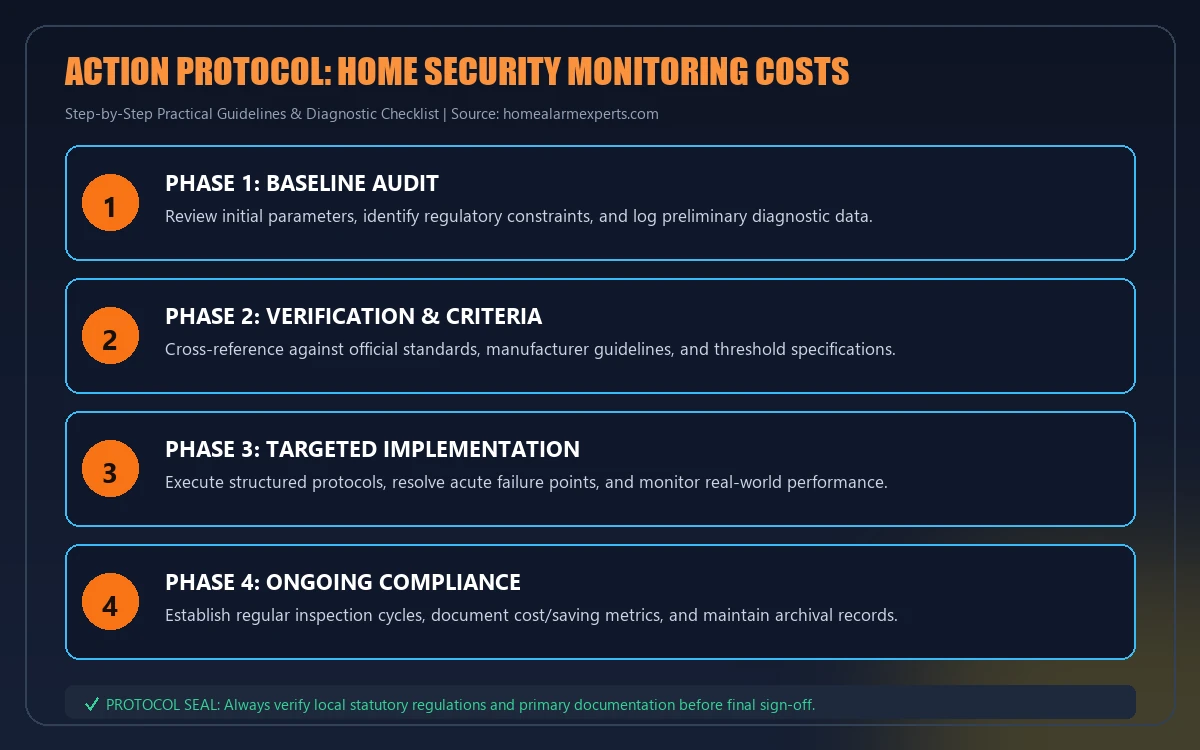
Before signing any monitoring contract in 2025, confirm three things in writing: the exact monthly rate after any promotional period expires; the early termination fee schedule and whether it scales linearly or front-loads penalties; and the cancellation method along with the number of days’ notice required.
The FTC rule does not cap monitoring fees or regulate pricing. Home security monitoring costs can still escalate mid-contract if the original agreement disclosed rate adjustment rights, which many do.
Calculating True Total Ownership Cost
Accurate home security monitoring costs accounting requires a 36-month total cost of ownership (TCO) model rather than a monthly subscription comparison. The following sample TCO uses a $1,800 annual premium baseline for a suburban homeowner in a Verified Response jurisdiction. Insurance discount figures are illustrative; actual savings depend on carrier-specific schedules confirmed in writing.
Basic Tier 2 plan at $20/month:
- 36-month subscription: $720
- Annual permit (3 years, per COPS-P014 documented municipal schedules): $225
- False-alarm fines (COPS-P014 documents 94%–98% false activation rates at the population level; individual household fine exposure depends on activation frequency and jurisdiction fine schedule): variable; budget $200–$400 for planning purposes
- Insurance discount captured: confirm percentage with carrier; apply to actual premium
- 36-month TCO: $1,145–$1,345 before insurance offset
Tier 4 video-verified plan at $50/month:
- 36-month subscription: $1,800
- Annual permit (3 years): $225
- False-alarm fines (ECV reduces dispatches 50%–70%, per ANSI/TMA CS-V-01): materially lower
- Insurance discount captured: confirm percentage with carrier; typically higher than Tier 2
- 36-month TCO: lower net cost in high-fine jurisdictions once insurance offset applied
The counter-intuitive result, visible once all variables are included, is that premium tiers frequently cost less over three years than basic plans in jurisdictions with aggressive false-alarm fine schedules or Verified Response policies that block dispatch on unverified signals. That is the arithmetic buried inside home security monitoring costs analysis that base-rate comparisons consistently miss.
Frequently Asked Questions
What factors drive home security monitoring costs above the advertised monthly rate?
Municipal alarm permit fees, false-alarm graduated fines, cellular backup surcharges, and contract early termination penalties all layer onto base subscription rates. In Verified Response jurisdictions, homeowners on basic plans face the risk of zero physical dispatch for unverified signals, which creates financial pressure to upgrade to video-verified tiers. The DOJ COPS-P014 data on 94%–98% false activation rates at the population level explains why municipalities have built aggressive fine schedules that directly inflate total annual security spend beyond what any subscription comparison chart captures.
Does a self-monitored alarm system qualify for a homeowners insurance discount?
Many carriers extend a modest premium reduction for any installed alarm system, monitored or not, because deterrence value exists regardless of central station involvement. DOJ/NIJ NCJ 243919 confirms that 8of offenders assess alarm presence before entry, validating the deterrence basis for that discount. The gap opens at the certified professional monitoring tier, where UL-listed central station accounts typically unlock larger reductions. Discount schedules vary by state DOI filings and carrier underwriting guidelines, so homeowners should request the specific applicable percentage in writing rather than relying on published ranges.
How does Enhanced Call Verification reduce false-alarm fine exposure?
ECV, standardized under ANSI/TMA CS-V-01, requires a central station to make at least two independent phone contact attempts to separate individuals before transmitting any dispatch request. That protocol reduces false alarm dispatches by 50%–70%, preventing municipal fines that accumulate at $100–$500 per incident under graduated fine schedules documented in COPS-P014. Beyond the direct fine savings, stations certified to CS-V-01 preserve dispatch credibility with local communications centers, which matters in Verified Response jurisdictions where an unverified signal receives "broadcast and file" handling regardless of subscription tier.
How does NFPA 72 Chapter 26 affect the price difference between budget and premium monitoring plans?
NFPA 72 Chapter 26 sets the engineering floor for certified supervising stations. Single-path cellular connections must be polled every 60 minutes, and a missed poll triggers a mandatory supervisory investigation. Dual-path LTE/IP configurations achieve near-real-time fault detection and qualify for higher dispatch priority classifications. The monthly cost gap between uncertified budget plans and certified Dual-Path Supervising Station accounts reflects the actual infrastructure cost of meeting those supervisory intervals. A homeowner on the cheapest cellular plan may be purchasing a system that goes dark during a broadband outage with no fault alert reaching the central station for up to 59 minutes, a coverage gap that no subscription comparison table makes visible.
References
-
Federal Trade Commission — Rule Concerning Recurring Subscriptions and Other Negative Option Plans (16 CFR Part 425)
URL: https://www.federalregister.gov/documents/2024/11/15/2024-25785/rule-concerning-recurring-subscriptions-and-other-negative-option-plans
Year: 2024
Benchmark: Mandates click-to-cancel parity and bans automatic multi-year rollover without affirmative consent. Regulates consent and cancellation mechanics for recurring monitoring subscriptions; does not cap pricing or grandfather ETF amounts. -
U.S. Department of Justice, COPS Office — False Burglar Alarms, Problem-Oriented Guides for Police Series (COPS-P014)
URL: https://cops.usdoj.gov/RIC/Publications/cops-p014-pub.pdf
Year: 2024
Benchmark: 94%–98% of residential alarm activations are false at the population level; municipal fine schedules range $100–$500 per incident after initial free dispatch; annual permit requirements documented across numerous U.S. jurisdictions. -
The Monitoring Association & ANSI — ANSI/TMA CS-V-01 Alarm Confirmation, Verification and Notification Procedures
URL: https://tma.us/standards/ansi-tma-cs-v-01/
Year: 2024
Benchmark: Minimum two independent ECV call attempts before dispatch; protocol reduces false alarm dispatches 50%–70%. -
National Fire Protection Association — NFPA 72 National Fire Alarm and Signaling Code, Chapter 26 Supervising Station Systems
URL: https://www.nfpa.org/codes-and-standards/nfpa-72-standard-development/72
Year: 2025
Benchmark: 60-minute supervisory polling interval for single-path cellular; immediate fault signaling for dual-path LTE/IP; drives monthly cost differential between uncertified and certified supervising stations. -
U.S. Department of Justice, NIJ — Understanding Decisions to Burglarize from the Offender Perspective (NCJ 243919)
URL: https://www.ojp.gov/ncjrs/virtual-library/abstracts/understanding-decisions-burglarize-offender-perspective
Year: 2024
Benchmark: 8of offenders actively assess alarm presence before entry; 60% abort immediately upon detecting a verified operational alarm system. Confirms professional monitoring deterrence baseline.