Written by: HomeAlarmExperts Building Science & Architectural Efficiency Desk (Architectural Building Science & Diagnostics Desk)
Fact-Checked & Reviewed by: HomeAlarmExperts Architectural Standards Review Board (Building Performance Standards Panel)
Standards: Current Architectural Edition | Building Code Compliant | Independent Verification | Direct building science verification against U.S. DOE EnergyStar & EPA Standards
Guidelines: Compliant with U.S. Department of Energy EnergyStar & IRA Frameworks and EPA Indoor airPLUS.
Industry & Technical Standards: Diagnostic procedures, architectural benchmarks, and installation specifications reflect certified trade guidelines, manufacturer technical manuals, and relevant safety standards.
Calculating true residential protection expense requires looking beyond promotional equipment discounts. Realistic home security installation cost ranges from $200 to $2,200 across baseline hardware, specialized installation labor, recurring subscription tiers. Hardware packaging rarely reveals total ownership expense. Unbudgeted municipal registration penalties, mandatory carrier connectivity fees, proprietary cloud storage tiers routinely inflate baseline estimates 40 percent over thirty-six months. Dissecting each technical layer before purchasing equipment establishes accurate long-term budgeting.
System evaluation demands inspecting low-voltage electrical codes, signal pathways, statutory enforcement mechanisms. Hardware selection governs long-term operational stability. Incomplete initial budgeting overlooks how physical installation choices dictate recurring dispatch fines across equipment operational lifespan. Reviewing trade guidelines alongside municipal false alarm enforcement schedules reveals that initial hardware savings vanish under cumulative false dispatch penalties. Evaluating trade guidelines against municipal enforcement schedules reveals true home security installation cost extends far past hardware acquisition. Quantifying technical variables before contractor commitment prevents severe lifecycle cost overruns.
What Drives Home Security Installation Cost: The Five-Layer Stack
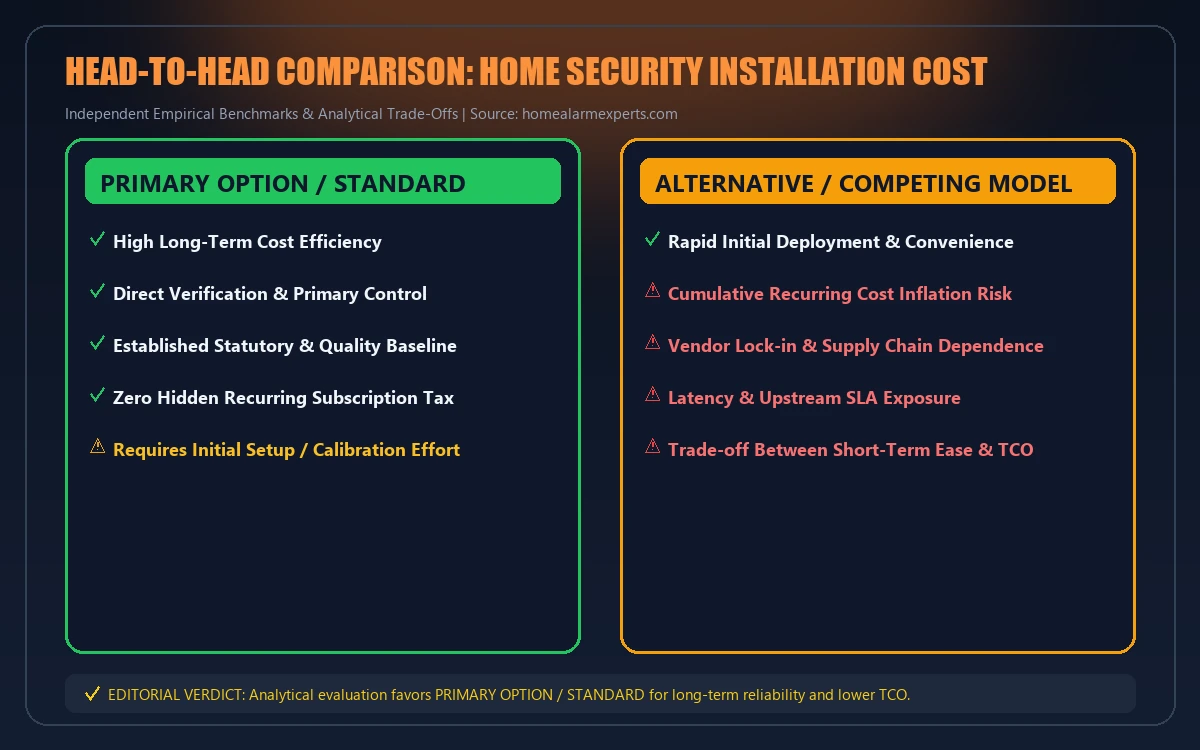
Equipment pricing represents initial point of sale. While basic wireless starter packages average between $200 and $450 with zero installation labor, professional hardwired systems require $600 to $1,200 for commercial hardware alongside baseline labor running $100 to $250 according to verified laboratory testing documented in Consumer Reports security system cost guide. Capital outlays extend past hardware acquisition. Comprehensive home security installation cost incorporates five structural layers dictating operational stability, physical code compliance, contractual liabilities over extended operational cycles.
+-------------------------------------------------------------------+
|               36-MONTH RESIDENTIAL COST STACK                     |
+-------------------------------------------------------------------+
| Layer 5: Regulatory Compliance (Permits: $30–$100/yr + Fines)     |
| Layer 4: Cloud Storage & Automation Uplinks ($12–$55/mo)          |
| Layer 3: Central Station Subscriptions ($39.99–$64.99/mo)         |
| Layer 2: Electrical Labor & NFPA 731 Code Standards ($150–$600)  |
| Layer 1: Physical Base Hardware & Intrusion Sensors ($200–$1,400) |
+-------------------------------------------------------------------+
Layer 1: Base Hardware and Edge Sensors. Entry packages feature central wireless gateway, magnetic reed switches, passive infrared motion detector. Expanding perimeter defense adds dual-technology microwave sensors, acoustic glass-break detectors, secondary arming stations, driving hardware expense between $700 and $1,100. Commercial-grade hardwired hardware incorporating supervised loop detection, auxiliary power supplies, tamper-resistant steel enclosures pushes component investment between $1,200 and $2,200 before technician dispatch.
Layer 2: Specialized Labor and Code Overhead. Professional structural wiring involves dedicated structural pathways rather than simple wire pulling. Compliance with NFPA 731 electronic security installation standard mandates physical separation between Class 2 low-voltage alarm conductors and standard alternating current circuits, requiring minimum 24-hour backup battery standby supply and rigid raceway physical protection across accessible structural areas. Meeting these architectural mandates demands 2 to 4 technician hours, adding $150 to $350 to baseline home security installation cost over unregulated wireless jobs, with complex physical conduit routing reaching $600.
Layer 3: Redundant Communication Hardware. Panels require off-site communication pathways when terrestrial broadband or utility power drops. Modern installations specify dual-path LTE uplinks routing encrypted signals across local internet networks and cellular towers simultaneously to eliminate single communication failure points. Equipment carrying this redundant architecture requires $8 to $15 monthly in cellular network maintenance fees, directly influencing overall home security installation cost over multi-year operational cycles.
Layer 4: Central Station Monitoring Subscriptions. Recurring monitoring contracts average $39.99 to $64.99 monthly, totaling $1,440 to $2,340 across standard three-year contracts. Subscription pricing varies based on cellular telemetry integration, round-the-clock central station supervision, video verification protocols. Under FTC negative option rule for monitoring contracts, recurring alarm contracts must provide cancellation flows matching enrollment ease, preventing cancellation traps historically burdening consumers. Evaluating service terms beforehand remains essential because contractual commitments control long-term operating expense.
Layer 5: Municipal Permitting and False Alarm Liability. Municipal administrative charges surprise unprepared property owners. Police agency response research compiled in DOJ false alarm dispatch and fee analysis reveals 94 to 98 percent of electronic alarm calls requiring emergency response represent false dispatches caused by user error or equipment malfunction. Municipalities respond with aggressive penalty structures: local jurisdictions assess fines from $50 to $250 per false activation after initial grace warnings, while annual permit registration adds $30 to $100 per address. Unmitigated sensor trips quickly accumulate $600 in municipal penalties, directly expanding overall home security installation cost over three operating years.
Hardware Costs by System Architecture
System topology controls upfront equipment invoices, long-term maintenance cycles, total home security installation cost. Wireless platforms emphasize rapid deployment and minimal entry expense. Hardwired platforms prioritize electrical permanence, circuit supervision, hardware durability over multiple decades.
| Architecture Type | Hardware Investment | Labor & Rough-In Scope | Circuit Supervision | Primary Uplink Path |
|---|---|---|---|---|
| DIY Wireless | $200–$450 | $0 (Self-installed) | Unsupervised | Single Wi-Fi / Optional Cellular |
| Pro Wireless | $450–$900 | $100–$250 (1–2.5 hrs) | Software Heartbeat | Dual-Path LTE Cellular / IP |
| Hardwired Pro (NFPA 731) | $700–$1,400 | $400–$850 (4.5–9 hrs) | End-of-Line Resistors | Dual-Path LTE Cellular / IP |
| Commercial Hybrid | $900–$1,800 | $600–$1,400 (6–14 hrs) | End-of-Line Resistors | Encrypted Dual-Path Cellular / IP |
Circuit supervision mechanisms determine lifetime dispatch stability. Unsupervised wireless loops identify open or closed states but cannot detect cut wiring, physical conductor tampering, transient line resistance fluctuations. Conversely, hardwired loops incorporate calibrated end-of-line resistors across terminal connections, creating electrical reference loops where resistance variations signal specific tamper trouble conditions instead of triggering false burglary alarms.
Supervised loops prevent false alarms. Installing supervised balance resistors increases initial home security installation cost by $150 to $250 in skilled labor, yet electrical balance prevents recurring municipal fines during severe temperature drops or mechanical wire degradation. Selecting supervised physical loops protects equipment from transient sensor chatter, balancing upfront labor investment with substantial long-term operational savings.
Hardwired Wiring Labor: Conduit Runs and NFPA Compliance
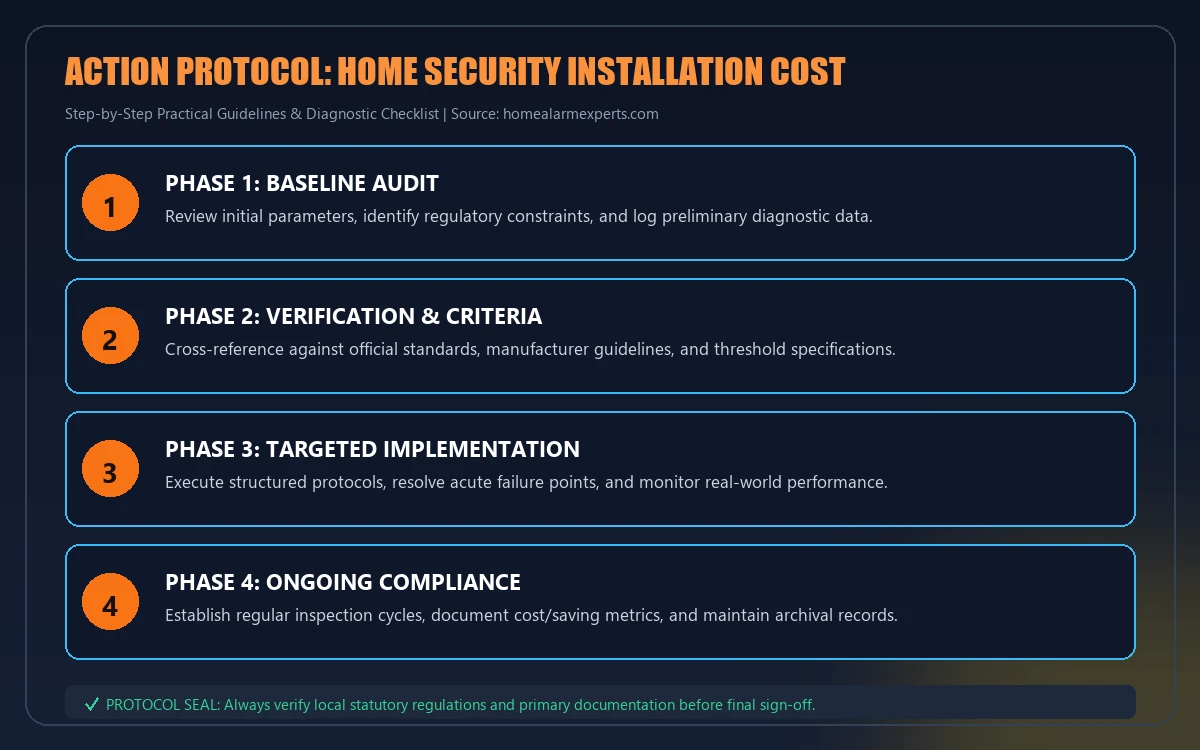
Structural wiring labor constitutes major portion of total home security installation cost across professional installations. Low-voltage electrical technicians divide labor into three stages: structural cable fishing, conduit raceway mounting, panel terminal commissioning. Technician billing rates follow transparent regional labor benchmarks:
- Suburban and non-metropolitan markets: $70 to $95 per billable technician hour.
- National median across metropolitan territories: $88 to $95 per billable technician hour.
- Dense union markets and coastal metropolitan regions: $115 to $145 per billable technician hour.
Across standard 2,000-square-foot residential structures, routing low-voltage cabling through finished framing demands variable labor hours matching architectural accessibility:
- Standard single-story pre-wired layout or open attic access: 4.5 technician hours ($400 total labor at $89/hr national baseline).
- Moderate retrofit with limited attic access requiring light wall fishing: 6 to 9 technician hours ($550 to $850 total labor at $90/hr).
- Complex multi-story retrofit through finished drywall with horizontal fire-blocking: 8 to 14 technician hours ($640 to $1,540 total labor at $80 to $110/hr).
WALL CROSS-SECTION: NFPA 731 LOW-VOLTAGE SEPARATION REQUIREMENT
+-------------------------------------------------------------+
|                                                             |
|  [ 120V AC Branch Circuit ]                                 |
|            |                                                |
|            |<--- MINIMUM 2-INCH SEPARATION AIR GAP -------->|
|            |     (OR METALLIC CONDUIT BARRIER)              |
|                                                |            |
|                           [ Supervised 22/4 Alarm Loop ]    |
|                                                             |
+-------------------------------------------------------------+
Raceway requirements introduce hardware and labor premiums. Under NFPA 731 electronic security installation standard, low-voltage security wiring running through unfinished basements, mechanical utility rooms, exposed exterior walls requires rigid metal conduit or intermediate metal raceways preventing physical damage and mechanical compromise. Conduit hardware and mounting junction boxes add $80 to $220 in materials. Bending, anchoring, grounding electrical metallic tubing adds 2 to 3.5 skilled labor hours ($150 to $350 overhead). When combined with raceway hardware, total Layer 2 labor and code compliance investment spans $150 to $600 over unregulated wireless installations.
Regional labor rates dictate ultimate balance of home security installation cost across different geographic markets. Metropolitan centers carrying prevailing wage mandates bill low-voltage technicians at elevated tiers. Midwestern suburban territories bill identical scopes at lower baselines. Code-compliant hardwired installations billing at $400 for 4.5 hours in Indianapolis often reach $650 in urban coastal settings purely due to regional labor variance.
Terminal termination and loop certification require systematic physical testing. Technicians measure direct current resistance balance across every zone loop, hook up dual sealed lead-acid backup batteries, test cellular handshake failover during simulated electrical blackout conditions. These diagnostic procedures demand 1.5 to 2.5 billable labor hours. Careful termination protects physical infrastructure, directly lowering false alarm risks and preserving total home security installation cost investment over time.
Sensor Certification Standards: UL 681 and Edge Reliability
Sensor build quality governs false alarm frequency. Entry-level intrusion packages utilize consumer-grade sensors lacking independent certification, leaving detection circuits vulnerable to radio frequency interference, thermal air currents, mechanical vibration. Professional systems specify sensors certified under UL 681 Standard for Installation and Classification of Burglar and Holdup Alarm Systems.
UL 681 defines rigid performance classifications for perimeter detection hardware. Certified sensors must incorporate internal physical tamper switches signaling control panels whenever covers are removed or mounting plates detached from walls. Certified passive infrared detectors require integrated thermal compensation circuits adjusting optical sensitivity as ambient room temperatures approach human body heat.
UL 681 SUPERVISED DUAL-TECHNOLOGY SENSOR ARCHITECTURE
+-------------------------------------------------------------+
|  Enclosure Tamper Switch (Normally Closed Circuit)          |
|   +-------------------------------------------------------+ |
|   | Dual-Tech Sensing Chamber                             | |
|   |  - Passive Infrared (PIR) Optical Fresnel Array       | |
|   |  - 10.525 GHz Microwave Doppler Radar Transceiver     | |
|   |  - Internal End-of-Line Balance Resistor (2.2k Ohm)   | |
|   +-------------------------------------------------------+ |
|        |                                           |        |
|  [ Both Channels Must Trigger ]           [ Anti-Mask Optical ]
|  [ To Signal Alarm Condition  ]           [ Trouble Alert Out ]
+-------------------------------------------------------------+
Dual-technology intrusion sensors combine passive infrared optical arrays with microwave Doppler transceivers. Alarms trigger only when both infrared heat signatures and physical microwave Doppler shifts register motion simultaneously. Integrating UL 681 certified intrusion sensors increases initial home security installation cost by $30 to $75 per detection zone over basic consumer components, adding $150 to $450 across typical residential footprints.
Certification standards mandate optical anti-masking protection across high-risk perimeter zones. Anti-masking sensors emit active infrared pulses across sensor lenses, immediately signaling system trouble alerts if intruders spray paint, tape, or place physical obstructions over detectors while systems are disarmed. Deploying certified sensing hardware stabilizes long-term home security installation cost by eliminating environmental false triggers that activate municipal penalty schedules.
Monitoring Subscriptions: Unbundling Communication and Storage Fees
Monthly invoices frequently conceal unbundled line items behind single subscription totals. Service charges segregate into central station dispatching, cellular telemetry leasing, cloud storage hosting, mobile software licensing.
MONTHLY MONITORING FEE: UNBUNDLED VS. BUNDLED RETAIL ($50–$100/MO)
+--------------------------------------------------------------+
| Core Central Station Dispatching (Wholesale Baseline: $12–$20) |
+--------------------------------------------------------------+
| Cellular Telemetry Carrier Bridge ($8–$15/mo)                 |
+--------------------------------------------------------------+
| Encrypted Cloud Video Retention (4 Cameras: $12–$30/mo)       |
+--------------------------------------------------------------+
| Remote Automation Platform Licensing ($5–$15/mo)             |
+--------------------------------------------------------------+
Central station dispatch forms core operational monitoring. Underwriters Laboratories listed facilities maintain redundant emergency generators, fault-tolerant telecommunications, certified human dispatchers round the clock. Wholesale operational cost for basic digital signal processing ranges from $10 to $18 per subscriber monthly, which alarm providers mark up to retail rates between $25 and $40 monthly.
Cellular communication uplinks generate persistent network expense. Standard broadband hubs route data across residential internet connections, exposing systems to service disruptions during physical wire cuts or utility outages. Enterprise-grade setups specify dual-path LTE bridges communicating with regional cellular towers. Carrier provisioning adds $8 to $15 monthly. Providers frequently bundle this data allocation into base rates or list it separately as cellular network access fees.
Cloud video retention represents significant subscription overhead. Smart cameras processing continuous 2K video require dedicated cloud bandwidth, server processing, storage infrastructure. Managing continuous motion classification and rolling 30-day encrypted retention for four cameras costs $12 to $35 monthly above baseline alarm monitoring. Evaluating monthly communication markups remains essential when calculating lifetime home security installation cost over multi-year service contracts.
Municipal Permits and False Alarm Penalty Economics
Municipal alarm administration imposes direct financial liability on property owners. Most incorporated cities require residents to register electronic alarm systems with municipal finance or police departments prior to system activation. Operating unregistered systems forfeits first-time violation waivers, triggering instant monetary fines upon initial emergency dispatch.
HYPOTHETICAL 3-YEAR MUNICIPAL PENALTY EXPOSURE
+--------------------------------------------------------------+
| Year 1: Permit ($40) + Incident 1 ($0) + Incident 2 ($75)    |
| Year 2: Permit Renewal ($40) + Incident 3 ($150)             |
| Year 3: Permit Renewal ($40) + Incident 4 ($250)             |
+--------------------------------------------------------------+
| THREE-YEAR ACCUMULATED MUNICIPAL EXPENSE: $595.00            |
+--------------------------------------------------------------+
Permit structures follow three administrative frameworks:
- Flat Annual Registration: Cities assess annual residential fees from $15 to $40 per property, requiring valid permit decals displayed on premises. Failing to secure annual permits triggers non-registration fines between $100 and $250 if emergency personnel respond to unverified alarm calls.
- Escalating False Dispatch Penalties: Municipalities utilize tiered penalty schedules penalizing chronic false calls. While initial false alarms receive written warnings, second dispatches cost $50 to $75, third activations incur $100 to $150, fourth and subsequent trips reach $250 to $500 per call.
- Full Cost Recovery Billing: Jurisdictions bill full police cruiser and personnel deployment costs if faulty sensors generate continuous dispatches. Single defective magnetic switches tripping repeatedly overnight generate hundreds of dollars in municipal penalty citations within 24 hours.
Empirical research published in DOJ false alarm dispatch and fee analysis originally established that 94 to 98 percent of electronic alarm calls represent false activations. That landmark 2004 study by Rana Sampson across multiple police departments documented how system user error and mechanical sensor drift overburden emergency services. Modern 2020s municipal ordinances enforce aggressive cost recovery matching these findings. Investing in hardwired circuit supervision and professional sensor calibration prevents severe penalty cycles, controlling lifetime home security installation cost through improved hardware reliability.
Cybersecurity Architecture and Home Security Installation Cost
Connecting alarm hubs to residential broadband networks creates digital attack surfaces. IP cameras, smart locks, digital keypads communicate over local wireless networks, exposing homes to network exploitation when robust encryption baselines are absent.
The NIST IR 8425 IoT cybersecurity standard, finalized in September 2022 as federal baseline criteria for consumer connected products, outlines mandatory requirements for hardware root of trust, cryptographic key separation, authenticated firmware updating mechanisms.
NIST IR 8425 HARDWARE-LEVEL ROOT OF TRUST AT THE PANEL GATEWAY
+-------------------------------------------------------------+
|  Tamper-Protected Hardware Enclosure                        |
|   +-------------------------------------------------------+ |
|   | Cryptographic Secure Element (Discrete TPM or SE)     | |
|   |  - Ephemeral Session Key Generation                   | |
|   |  - Asymmetric Mutual Authentication                   | |
|   |  - Hardware Root of Trust for Signed Firmware         | |
|   +-------------------------------------------------------+ |
|        |                                           |        |
|        v                                           v        |
|  [ Encrypted Dual-Path LTE ]            [ Local Sensor Bus ]|
+-------------------------------------------------------------+
Meeting federal cybersecurity baselines adds $25 to $45 per base station to equipment manufacturing bills of materials. Compliant gateways integrate discrete cryptographic hardware secure elements, such as dedicated trusted platform modules, to store private authentication keys and enforce mutual transport layer encryption. Uncertified consumer hubs omit discrete secure elements, storing network credentials in plain flash memory vulnerable to local network extraction.
Hardware cybersecurity validation represents essential element of modern home security installation cost ensuring edge devices resist unauthorized digital access. Enterprise-grade panels built to NIST IR 8425 standards reject unsigned firmware modifications and enforce end-to-end encryption across local and remote transmissions. Investing in certified hardware prevents malicious actors from remotely suppressing sirens or intercepting video feeds.
DIY vs. Professional Installation: 36-Month Cost Reconciliation
Low equipment pricing often disguises long-term operational liabilities. Evaluating complete home security installation cost across thirty-six months requires balancing equipment purchase prices against installation labor and false dispatch fines.
36-MONTH LIFECYCLE TCO: DIY WIRELESS VS. PROFESSIONAL HARDWIRED
+--------------------------------------------------------------+
| DIY Wireless Total: $2,189.64                                |
|   [HW: $350] [Labor: $0] [Sub: $1,439.64] [Permits/Fines: $400]
+--------------------------------------------------------------+
| Pro Hardwired Total: $2,789.64                               |
|   [HW: $850] [Labor: $400] [Sub: $1,439.64] [Permits/Fines: $100]
+--------------------------------------------------------------+
| INITIAL HARDWARE & LABOR DELTA: $900.00                      |
| THREE-YEAR DISPATCH FINE REDUCTION: -$300.00                 |
| NET 36-MONTH DIFFERENTIAL: $600.00                           |
+--------------------------------------------------------------+
Controlled testing documented in Consumer Reports security system cost guide indicates DIY systems experience 35 percent higher user-error dispatches during initial 60 days of operation compared to professionally installed systems. Early operational windows directly collide with municipal penalty schedules transitioning addresses from warnings to cash fines.
System Scenario A: Consumer DIY Wireless Platform
- Baseline hardware kit (hub, 4 door contacts, 1 motion detector): $350.00
- Structural installation labor: $0.00
- Standard monitoring subscription ($39.99/mo for 36 months): $1,439.64
- Municipal alarm registration permit ($25.00/yr for 3 years): $75.00
- Two false alarm penalties within thirty-six months ($100 second call + $225 third call): $325.00
- Total 36-Month Operational Commitment: $2,189.64
System Scenario B: Code-Compliant Professional Hardwired Platform
- Commercial hardware components (NFPA 731 panel, balance resistors, metal cabinet): $850.00
- Professional installation labor (4.5 hours skilled rough-in and termination at $89/hr): $400.00
- Standard monitoring subscription ($39.99/mo for 36 months): $1,439.64
- Municipal alarm registration permit ($25.00/yr for 3 years): $75.00
- False alarm penalties (1 minor first-tier dispatch): $25.00
- Total 36-Month Operational Commitment: $2,789.64
Professional hardwired systems command $900 initial pricing premium over self-installed equipment ($1,250 hardware and labor versus $350 DIY hardware). That financial gap narrows over three operating years. Hardwired loop supervision saves $300 in municipal penalties ($25 versus $325), reducing net 36-month differential to exactly $600 ($2,789.64 versus $2,189.64). Hardwired architecture with balanced loop supervision minimizes false activations caused by battery depletion, RF packet loss, sensor drift. Evaluating long-term reliability against immediate hardware invoices confirms overall home security installation cost reflects operational resilience rather than upfront equipment discounts.
Statutory Compliance: NFPA 731 and FTC Negative Option Enforcement
Federal regulations and trade standards dictate electrical safety procedures, equipment mounting, subscription cancellation terms.
The NFPA 731 electronic security installation standard enforces Class 2 power-limited wiring separation from primary AC power circuits. Conductors traversing wall studs require physical steel strike plates or conduit sleeves preventing puncture damage from drywall screws. Non-compliant wiring creates fire hazards and insurance liability, while mandatory structural remediation can double initial home security installation cost.
Federal administrative mandates protect homeowners from predatory subscription agreements. Published in Federal Register on November 4, 2024, the FTC negative option rule for monitoring contracts enforces strict consumer cancellation protections:
- Core disclosure provisions and misrepresentation bans took effect January 3, 2025 (60 days post-publication).
- Parity cancellation mandates ("click-to-cancel") and annual recurring subscription reminders take mandatory effect May 3, 2025 (180 days post-publication).
Under these provisions, alarm companies cannot require certified mail letters or phone retention loops if consumers enroll digitally. Eliminating mandatory certified-mail cancellation loops protects consumers from inflated home security installation cost driven by recurring monthly billing traps.
Long-Term Maintenance and Sensor Replacement Cycles
Equipment maintenance creates ongoing ownership expense after installation. Wireless sensors utilize lithium coin cells or cylindrical CR123A batteries requiring systematic replacement. Standard residential footprints deploying twenty perimeter sensors consume fresh cells every three to four years, adding $60 to $120 per service cycle.
Hardwired panels depend on sealed lead-acid or lithium-iron-phosphate backup batteries sustaining panel operations during utility outages. The NFPA 731 electronic security installation standard requires backup power supplies to sustain panel operations for 24 hours in standby mode followed by 5 minutes of continuous siren operation. Sealed lead-acid batteries degrade from ambient heat and constant float charging, requiring replacement every three to four years at $35 to $75 per battery pack. Factoring scheduled battery replacement into long-term financial budgets ensures realistic projections of home security installation cost across decade-long operational horizons.
COMPONENT SERVICE LIFECYCLES AND MAINTENANCE BUDGETS
+--------------------------------------------------------------+
| Lead-Acid Standby Batteries: Replace 3–4 Years ($35–$75)     |
| Wireless Sensor Lithium Cells: Replace 3–5 Years ($60–$120)  |
| Optical Smoke & CO Chambers: Clean Annually, Replace 10 Yrs  |
| PIR Motion Fresnel Lenses: Inspect & Clean 24 Months         |
+--------------------------------------------------------------+
Exterior optical sensors demand scheduled environmental maintenance. Passive infrared lenses exposed to direct sunlight degrade from ultraviolet radiation, reducing sensitivity within five to seven years. Dust and spider webs accumulating inside optical chambers generate intermittent false trips triggering police response. Annual preventative maintenance balances upfront home security installation cost against recurring lifecycle deterioration.
Frequently Asked Questions
What is average home security installation cost for 2,000-square-foot house?
Code-compliant hardwired setups across 2,000-square-foot homes average $1,350 to $2,250 for hardware and professional labor. Hardware investment runs $800 to $1,400 for NFPA 731 compliant panels, 8 to 12 monitored zones with end-of-line resistors, dual-path LTE communicators, backup power. Specialized low-voltage installation labor demands 6 to 9 technician hours ($550 to $850 at $90/hr median rates) covering structural cable fishing, sensor mounting, loop resistance calibration. Self-installed wireless equipment for identical layouts runs $350 to $650 upfront, but trades electrical durability for higher battery maintenance and elevated false dispatch risks. Total home security installation cost for standard residential layouts breaks down into predictable component hardware, specialized labor hours, code compliance mandates.
How do recurring monthly alarm monitoring charges break down across service tiers?
Wholesale central station dispatch processing through UL-listed facilities costs alarm providers $10 to $18 monthly, marked up to retail rates of $25 to $40 for basic landline or broadband monitoring. Adding dual-path cellular telemetry introduces $8 to $15 monthly carrier access charges. Video retention tiers supporting four high-definition cameras with cloud motion analysis add $12 to $35 monthly, while smart automation platforms add $5 to $15. Comprehensive bundles with video verification and home automation routinely reach $65 to $95 monthly.
Why do municipal alarm permit fees and false dispatch fines vary across regional jurisdictions?
Local governments structure independent alarm ordinances to recover municipal costs from emergency responses. Because empirical police data documents 94 to 98 percent of electronic security dispatches are false activations, cities utilize fees to fund administrative processing and deter chronic system malfunctions. Annual permits range from $15 to $100, while progressive penalty structures levy escalating fines from $50 to $500 per incident after initial warnings. Unregistered systems forfeit courtesy waivers, incurring instant financial citations upon first dispatch.
How does dual-path cellular telemetry improve residential alarm reliability over home broadband?
Standard broadband alarm communicators depend on residential modems, consumer routers, exterior utility wiring. Physical cable cuts, neighborhood utility blackouts, equipment crashes sever off-site signal paths completely. Dual-path communicators transmit data packets across residential internet and encrypted cellular networks simultaneously. If broadband pathways drop, cellular modules route emergency signals directly to monitoring centers within seconds, sustaining life-safety reporting integrity under severe weather or physical line tampering.
References
-
National Fire Protection Association (NFPA) — NFPA 731 Standard for Installation of Electronic Premises Security Systems
https://www.nfpa.org/codes-and-standards/nfpa-731-standard-development/731
Mandates physical separation of Class 2 low-voltage alarm circuits from alternating current wiring, 24-hour backup battery standby reserves, physical raceway protection across exposed areas, adding $150 to $350 in specialized installation labor over unregulated setups. -
Federal Trade Commission (FTC) — 16 CFR Part 425 Negative Option Rule
https://www.federalregister.gov/documents/2024/11/04/2024-24016/trade-regulation-rule-on-negative-option-plans
Federal trade regulation published November 2024 mandating cancellation mechanisms match enrollment ease, taking phased effect January 2025 for disclosure mandates and May 2025 for click-to-cancel operational parity on recurring monitoring contracts. -
National Institute of Standards and Technology (NIST) — NIST IR 8425: Profile of the IoT Core Baseline for Consumer IoT Products
https://csrc.nist.gov/pubs/ir/8425/final
Finalized September 2022, establishing federal cybersecurity baseline standards for connected consumer devices including hardware root of trust, cryptographic key separation, authenticated firmware provisioning. -
Consumer Reports — Home Security System Buying Guide and Lab Benchmarks
https://www.consumerreports.org/home-garden/home-security-systems/buying-guide/
Documents standard professional installation labor ranges from $100 to $250 with $600 to $1,200 hardware packages, noting DIY systems experience 35 percent higher false dispatches during initial 60 days of operation. -
Center for Problem-Oriented Policing / U.S. Department of Justice COPS Office — False Alarms, 2nd Edition
https://popcenter.asu.edu/content/false-alarms-2nd-ed
Rana Sampson, 2004. Documents empirical police response data showing 94 to 98 percent of residential alarm calls represent false activations, prompting municipal cost-recovery fee schedules and permit structures across North American jurisdictions.