Written by: HomeAlarmExperts Building Science & Architectural Efficiency Desk (Architectural Building Science & Diagnostics Desk)
Fact-Checked & Reviewed by: HomeAlarmExperts Architectural Standards Review Board (Building Performance Standards Panel)
Standards: Current Architectural Edition | Building Code Compliant | Independent Verification | Direct building science verification against U.S. DOE EnergyStar & EPA Standards
Guidelines: Compliant with U.S. Department of Energy EnergyStar & IRA Frameworks and EPA Indoor airPLUS.
Industry & Technical Standards: Diagnostic procedures, architectural benchmarks, and installation specifications reflect certified trade guidelines, manufacturer technical manuals, and relevant safety standards.
Published rates conceal systemic liabilities. The published home alarm monitoring cost presented in direct-to-consumer advertising ranges between $15 and $65 per month, yet this retail subscription represents merely an initial ledger line within a complex property-protection infrastructure. Unmonitored systems avoid recurring monthly charges entirely, but professional central station coverage introduces mandatory capital commitments for continuous line supervision, carrier transmission capacity, municipal registration, and recurring hardware maintenance. Nominal estimates routinely fail to address cellular communicator deprecation cycles, hardware financing encumbrances, and municipal penalties triggered by mechanical sensor faults or atmospheric pressure anomalies. Calculating accurate life-cycle expenses demands an exhaustive examination of recurring subscription rates alongside hardware ownership structures, communications pathway overhead, and municipal regulatory enforcement frameworks.
+---------------------------------------------------------------------------------------------------+
|                     AGGREGATE RESIDENTIAL MONITORING COST COMPOSITION                             |
+---------------------------------------------------------------------------------------------------+
|  [ Base Signal Routing Subscription ]   ---> 35% - 55% of recurring expenditure                   |
|  [ Dual-Path Cellular Transceiver Fee ] ---> 15% - 25% of monthly carrier carriage                |
|  [ Municipal FARO Registration / Fines ] ---> 10% - 20% of annual operational liability           |
|  [ Hardware Amortization & Upgrades ]   ---> 15% - 25% of annualized equipment life cycle         |
+---------------------------------------------------------------------------------------------------+
Evaluating baseline home alarm monitoring cost requires separating pure central station signal dispatching from bundled equipment amortizations that alarm vendors use to obscure long-term consumer debt. Entry-tier landline or broadband IP configurations advertise rock-bottom operating expenditures, yet they introduce severe operational vulnerabilities when physical transmission lines experience utility disruption, grounding failure, or deliberate sabotage. Modern physical security diagnostic reviews mandate high-integrity cellular uplinks to maintain constant off-premises supervision. As building envelopes grow increasingly insulated through dense low-emissivity glazing, continuous exterior foil vapor retarders, and metallized thermal barriers, internal radio-frequency propagation diminishes significantly. This physical degradation forces homeowners into secondary external antenna installations, signal booster relays, or higher-tier cellular communicator subscriptions that immediately escalate ongoing operational commitments.
Baseline Home Alarm Monitoring Cost Across Modern Delivery Architectures
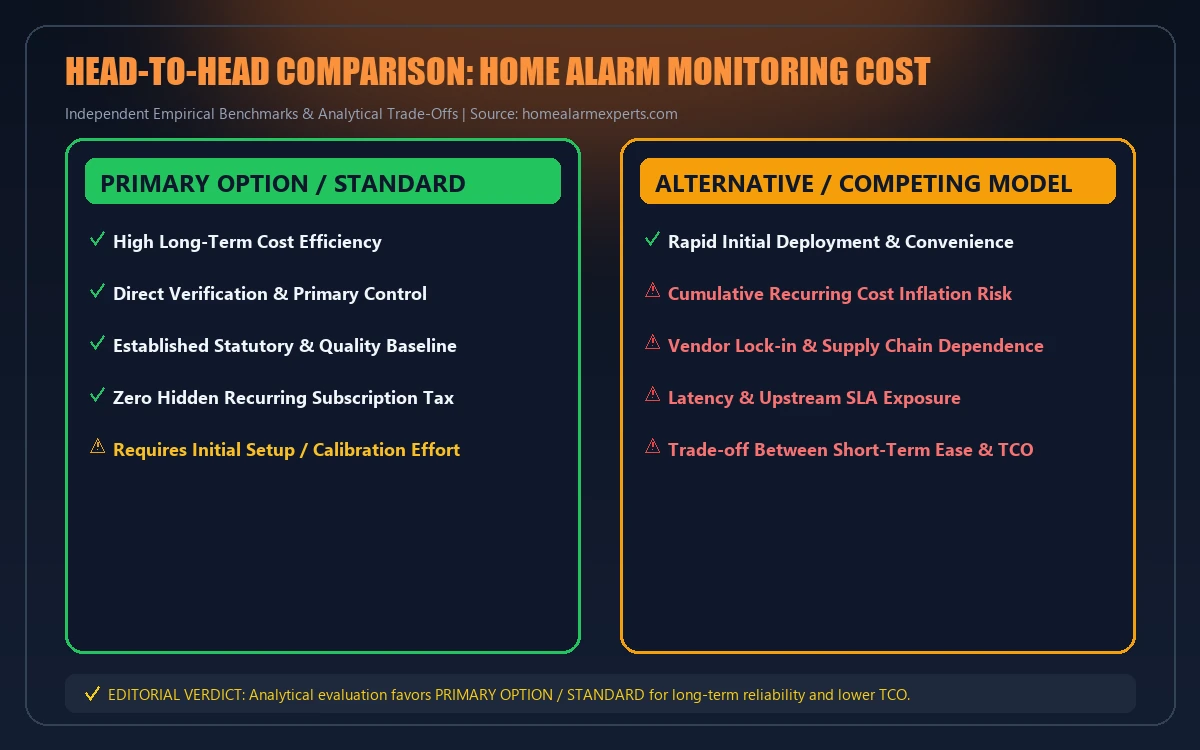
Signal transmission architecture establishes the baseline financial commitment for off-premises alarm supervision. A comprehensive professional monitoring fee comparison reveals clear operational divisions between self-installed wireless platforms, legacy hardwired panels retrofitted with IP cards, and proprietary closed-protocol enterprise installations. Modern residential systems route event frames through one of three pathways: pure Internet Protocol transmission via Ethernet or local Wi-Fi, dedicated cellular uplinks utilizing commercial Long-Term Evolution carrier spectrum, or redundant dual-path arrangements combining local broadband with a secondary cellular transceiver.
For properties utilizing basic IP-only routing pathways, entry-level home alarm monitoring cost ranges between $15 and $25 per month. This tier provides continuous communication with an off-site central station, but network reliability depends entirely on local utility uptime, premises router power supplies, and uninterrupted Internet service provider connectivity. If power fails and the premises router lacks an uninterruptible power supply, off-premises reporting collapses instantly.
Adding primary or secondary cellular infrastructure causes the typical home alarm monitoring cost to climb to $35 through $60 monthly. This monthly increment compensates for commercial cellular SIM card provisioning, dedicated carrier bandwidth allocation, continuous line-polling handshakes, and higher liability insurance maintained by certified central monitoring centers. For consumers selecting enterprise-grade automation platforms with integrated video verification, high-frequency line polling, and secondary multi-carrier redundancy, recurring charges frequently exceed $70 to $90 per month.
The table below outlines baseline expenditures across standard market configurations, documenting initial outlay, monthly subscription parameters, transmission latency, and secondary infrastructure dependencies.
| Monitoring Delivery Tier | Typical Upfront Hardware Expense | Monthly Base Monitoring Fee | Signal Transmission Medium | UL 827 Line Polling Frequency | Five-Year Cumulative Expenditure |
|---|---|---|---|---|---|
| Broadband IP Only (Self-Installed) | $200 – $450 | $15 – $25 | Local Wi-Fi / Ethernet | 60 – 180 Minutes | $1,100 – $1,950 |
| Cellular Single-Path (Consumer Hybrid) | $300 – $600 | $30 – $45 | Dedicated LTE/5G Cellular | 10 – 60 Minutes | $2,100 – $3,300 |
| Dual-Path IP & Cellular (Commercial Grade) | $500 – $1,200 | $45 – $65 | Dual-Path IP / Cellular | 200 Seconds – 6 Minutes | $3,200 – $5,100 |
| Proprietary Financed Ecosystem | $0 – $199 (Front) | $55 – $85+ | Cellular with App Automation | 10 – 30 Minutes | $3,300 – $5,299+ |
| Self-Monitored (Local Smart Siren Only) | $250 – $700 | $0 (No Police Dispatch) | Push Notifications / IP | None (Unsupervised) | $250 – $700 |
Evaluating these tiers demonstrates that a zero-down hardware offer produces the highest cumulative expenditure over standard ownership horizons. When vendors subsidize control panels, motion digitizers, and peripheral door transceivers, they recover hardware manufacturing costs by embedding capital amortization inside inflated monthly service contracts. A low upfront expenditure invariably compounds into an aggressive recurring home alarm monitoring cost that strains household maintenance allocations over a five-year lifecycle.
Signal Delivery Protocols and Cellular Infrastructure Realities
Transmission speed dictates protective capability. In professional central station operations, signal delivery protocols determine how rapidly life-safety alarms travel from customer premises transceivers to automated dispatch consoles. Standard systems leverage Contact ID, SIA Digital Communication Standard, or proprietary JSON-based payloads over TCP/IP and UDP channels to transmit alarm codes, partition metrics, and peripheral battery diagnostics.
Signal routing standards require strict technical verification. Monitoring stations holding a UL 827 central-station monitoring standard certification must maintain redundant internal power generation, mirrored communications processing, physical signal pathway survivability, and round-the-clock staffing capable of processing high-priority intrusion signals within 45 seconds of initial ingestion. Technical compliance with these operational standards drives the baseline operational costs that accredited monitoring bureaus charge downstream service providers. When an installation includes life-safety fire sensors alongside intrusion panels, UL 827 mandates elevated line supervision frequency, forcing communicators to verify network continuity every few minutes rather than once an hour.
+---------------------------------------------------------------------------------------------------+
|                 UL 827 DUAL-PATH ENCRYPTED TRANSMISSION FLOW ARCHITECTURE                         |
+---------------------------------------------------------------------------------------------------+
|  [ Customer Premises Panel ]                                                                      |
|          |                                                                                        |
|          +--> Primary Path: AES-256 IP Packet ---> Broadband Network ---> [ Receiving Station ]  |
|          |    (Latency: < 3 Seconds | Polled: Every 180 Seconds)                  |               |
|          |                                                                        v               |
|          +--> Secondary Path: LTE/5G RF Uplink ---> Cellular Tower   ---> [ Signal Ingestion ]    |
|               (Latency: 5-12 Seconds | Failover: Immediate)                       |               |
|                                                                                   v               |
|                                                                    [ Operator Action: < 45s ]     |
+---------------------------------------------------------------------------------------------------+
Evaluating cellular backup alarm pricing requires inspecting physical transmission hardware directly. While local Wi-Fi networks transmit data at high speeds without incremental bandwidth costs, they remain prone to localized infrastructure failures, power transformer blowouts, and physical telephone-line cuts. Cellular backup resolves these structural vulnerabilities by transmitting encrypted packets directly to nearby commercial cellular masts, bypassing hardwired landline cables. However, providing redundant cellular transceivers introduces carrier SIM maintenance costs, data carriage fees, and network transition overhead that push the standard home alarm monitoring cost higher over the life of the system.
Technological transitions in mobile carrier networks introduce recurrent hardware replacement cycles that homeowners rarely account for during contract execution. As documented in the FCC 3G cellular phase-out advisory, the scheduled decommissioning of legacy third-generation wireless infrastructure rendered millions of operational alarm communicators obsolete overnight. Homeowners operating older control systems were forced to spend between $100 and $350 for upgraded LTE or 5G communicator boards simply to preserve central station signal continuity. Incorporating these periodic hardware migrations into predictive building maintenance schedules is necessary to determine true lifecycle home alarm monitoring cost across modern properties.
Hidden Surcharges That Inflate Effective Home Alarm Monitoring Cost
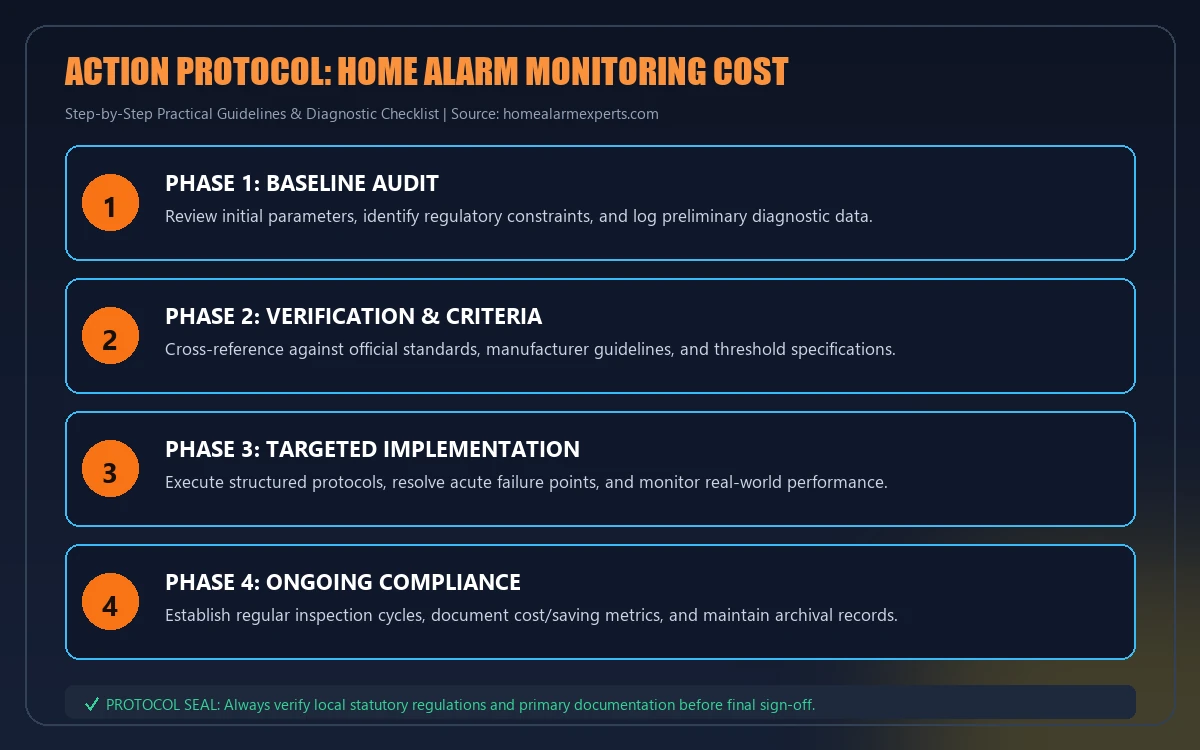
Introductory contract rates mask critical operational expenses. The most pervasive distortions in residential security billing stem from equipment financing mechanisms, administrative processing surcharges, and locked hardware architectures. Many national service providers deploy door-to-door sales teams offering sophisticated touchscreen panels and peripheral sensors at nominal upfront charge, obscuring the legally binding obligations tied to these promotions.
Proprietary firmware lock-in prevents consumers from transferring installed hardware to lower-cost monitoring providers. When an equipment provider flashes custom, encrypted firmware onto digital dialers or wireless transceivers, the control panel communicates exclusively with that vendor’s proprietary receiver network. If a consumer cancels monitoring, the central communicator deactivates, leaving the alarm panel unable to transmit events to open-source or independent monitoring bureaus. Replacing an intentionally disabled master panel, secondary keypads, and incompatible proprietary wireless sensor transmitters costs between $300 and $800, creating a significant barrier to switching providers that allows incumbents to steadily increase their recurring home alarm monitoring cost without losing subscribers.
+---------------------------------------------------------------------------------------------------+
|                       EQUIPMENT LOCK-IN VERSUS OPEN-PROTOCOL UPGRADE PATH                         |
+---------------------------------------------------------------------------------------------------+
|  PROPRIETARY ARCHITECTURE:                                                                        |
|  [ Locked Transceiver ] ---> Encrypted Handshake ---> [ Vendor Station ] ---> Terminal Lock-Out   |
|  * Cancellation Result: Communicator brinks; requires full $400-$800 panel replacement.          |
|                                                                                                   |
|  OPEN ARCHITECTURE (SIA / CONTACT ID):                                                            |
|  [ Unlocked Dial/IP ]   ---> Standard Protocol ---> [ Any UL 827 Station ] ---> Portability      |
|  * Cancellation Result: Firmware repointed via installer code in 10 minutes; hardware preserved.  |
+---------------------------------------------------------------------------------------------------+
Hardware financing contracts frequently decouple physical equipment debt from ongoing signal monitoring. Rather than presenting a simple unified agreement, some sales organizations split the monthly invoice into a modest monitoring charge and an expensive, non-cancelable equipment loan spanning 36 to 60 months.
These practices have generated significant federal scrutiny. As highlighted in the landmark FTC Vivint smart home enforcement action, regulators issued a $20 million penalty against deceptive practices where unauthorized credit reports were utilized to bind consumers into deceptive 60-month hardware financing agreements that operated independently of the base monitoring agreement. Even if a property owner terminated service due to poor signal coverage or unsatisfactory response times, they remained legally obligated to service the remaining equipment balance, driving their effective home alarm monitoring cost far beyond initial sales projections.
Additional auxiliary fees systematically erode initial promotional savings:
- Cellular Network Bridge Upcharges: Charging $5 to $15 per month above base subscription rates for access to private cellular APNs.
- Interactive Mobile Application Licensures: Surcharges of $3 to $10 monthly for basic mobile push arming, status tracking, and event histories.
- Video Verification Ingestion Fees: Additional cloud retention surcharges of $5 to $20 per month for storing ten-second pre-alarm motion captures.
- Annual System Health Diagnostic Levies: Automated administrative testing line-charges ranging from $15 to $45 annually to verify network reporting integrity.
Factoring in these recurring surcharges demonstrates why a seemingly economical $29.99 monthly retail package frequently becomes an authentic home alarm monitoring cost exceeding $55 each billing cycle.
Municipal Ordinances, Dispatch Levies, and Verification Protocols
Emergency response is not an automatic public entitlement. Municipal law enforcement agencies manage finite operational budgets and dispatch assets according to strict public safety priorities. When a residential security system transmits an intrusion code to a central station, dispatch operators relay that request directly to the regional Public Safety Answering Point (PSAP) via Computer-Aided Dispatch (CAD) or dedicated phone consoles.
False dispatches drain municipal emergency infrastructure. Authoritative empirical findings from the DOJ COPS false burglar alarms analysis show that 94% to 98% of all residential burglar alarm activations across American municipalities are false alarms, triggered by occupant handling errors, environmental pressure swings, unstable door latches, or wandering indoor domestic pets. This overwhelming false-alarm rate has prompted local governments to pass aggressive regulatory countermeasures that directly affect property owners.
+---------------------------------------------------------------------------------------------------+
|               MUNICIPAL FALSE ALARM REDUCTION ORDINANCE (FARO) ESCALATION SCALE                   |
+---------------------------------------------------------------------------------------------------+
|  Activation Incident #1: First Unverified Dispatch   ---> $0 (Warning / Registration Audit)       |
|  Activation Incident #2: Second Mechanical Error     ---> $50 - $100 Direct Civil Fine            |
|  Activation Incident #3: Third Atmospheric Trigger   ---> $150 - $250 Escalated Municipal Penalty |
|  Activation Incident #4+: Chronic False Dispatches   ---> $350 - $500 + Blacklist / Suspended     |
+---------------------------------------------------------------------------------------------------+
Local governments increasingly combat service burdens by adopting a strict false alarm reduction ordinance (FARO). These municipal statutes require property owners to secure operational permits before connecting alarm systems to professional dispatch centers. False alarm permit fees cost between $25 and $100 annually, depending on municipal location. Operating an active security system without an approved alarm permit carries mandatory administrative fines, and central stations may be prohibited from requesting emergency dispatch to unpermitted addresses.
Operating costs increase sharply when mechanical false alarms trigger municipal penalty schedules. While many municipal jurisdictions forgive the initial false run during an annual permit cycle, subsequent unverified dispatches trigger non-negotiable fines:
- First Unverified Dispatch: Written warning or small $25 administrative tracking charge.
- Second Unverified Dispatch: Civil citation assessing $50 to $100.
- Third Unverified Dispatch: Escalated penalty ranging between $150 and $250.
- Subsequent Dispatches: Severe punitive fees spanning $350 to $500 per callout, accompanied by temporary placement on a non-response blacklist.
Accumulating two or three false alarms in a single calendar year can generate municipal penalties that exceed the entire annual home alarm monitoring cost paid to an alarm vendor.
To mitigate municipal false-alarm liabilities, modern building diagnostic standards require robust physical verification. Integrating dual-technology intrusion sensors (combining passive infrared sensors with microwave Doppler radar) minimizes atmospheric thermal trip events. Central monitoring stations increasingly mandate video verification protocols or dual-call verification (calling two distinct authorized telephone contacts before contacting emergency dispatch). Implementing these operational safeguards limits exposure to escalating municipal fines, keeping effective long-term home alarm monitoring cost within predictable operational parameters.
Contract Governance, Negative Option Billing, and Statutory Cancellation Rights
Multi-year contracts historically anchored the residential alarm industry. Conventional security monitoring companies commonly bound consumers to agreements spanning 24, 36, or even 60 months. These documents contained aggressive indemnification language, automatic liquidated damages clauses, and restrictive assignment provisions that permitted companies to trade account ledgers without customer permission while prohibiting consumers from canceling service when moving.
Negative option billing rollover represented an industry-standard mechanism for locking in ongoing subscriber revenue. Under these standard terms, a three-year contract automatically renewed for another full 12 to 24 months unless the homeowner sent a certified, return-receipt cancellation letter within a narrow 30-day notice window before the original term expired. If a property owner missed this window, they faced continuous billing or steep early termination penalties demanding up to 90% of the remaining contract balance.
Regulatory shifts have begun curbing these restrictive renewal tactics. Under the comprehensive FTC negative option rule 16 CFR Part 425, federal law mandates click-to-cancel parity for subscription services, barring companies from rolling consumers into automatic renewals without unambiguous consent and an accessible cancellation process. Central stations and monitoring providers must provide cancellation mechanisms that are as straightforward as the initial enrollment workflow, removing barriers designed to prevent consumers from migrating to more competitive providers.
When reviewing service terms to determine real home alarm monitoring cost, property owners must audit three key legal provisions:
- Written Notification Intervals: Ensure the agreement permits service termination with a standard 30-day written notice at any point following the initial term, voiding automated multi-year extensions.
- Equipment Ownership Transfer Clauses: Verify that physical control panels, auxiliary communicators, and peripheral sensors become property of the homeowner upon installation rather than remaining leased inventory subject to vendor reclamation.
- Relocation Release Policies: Guarantee that selling the residential property automatically terminates the service agreement without accelerated early-termination penalties if the incoming buyer declines to assume the contract.
Inspecting contract terms shields consumers from ongoing fee increases, ensuring that unexpected contractual liabilities do not compound long-term home alarm monitoring cost over decades of continuous homeownership.
Strategic Selection Framework for Long-Term Monitoring Expenditure
Managing life-safety systems effectively requires evaluating total cost of ownership across multi-year operating horizons. Calculating pure home alarm monitoring cost requires balancing upfront equipment investments against recurring monthly carrier allocations, potential false-dispatch risks, and future cellular transceiver obsolescence. Equipment choices fundamentally shape recurring financial commitments; open-protocol hardware allows owners to switch monitoring bureaus easily, whereas proprietary hardware ties the property to a single provider’s rate structure.
Property owners must balance life-safety coverage requirements against the long-term cost of contract lock-in. Investing in non-proprietary, open-architecture control platforms that support standard SIA Contact ID formats allows homeowners to partner with competitive, unbundled monitoring stations charging fair, market-clearing rates. Bypassing subsidized consumer promotions protects homeowners from inflated hardware financing arrangements, proprietary communicator bricking, and punitive multi-year contracts that misrepresent initial system pricing.
Conducting periodic audits of signal delivery pathways, battery states, municipal permit renewals, and sensor calibration metrics limits false alarms and municipal penalties. When implemented methodically, this diagnostic approach manages the true home alarm monitoring cost, delivering reliable life-safety protection that preserves residential property without introducing unpredictable financial liabilities.
Frequently Asked Questions
What is the average home alarm monitoring cost for a residential property?
Residential monitoring typically costs between $15 and $65 per month, depending on transmission infrastructure, response tiers, and platform features. Basic internet-protocol or telephone-line signal routing occupies the lowest tier, spanning $15 to $25 monthly. Adding primary or redundant cellular communicators increases the baseline to $35 through $50 per month, reflecting commercial carrier data and line-supervision requirements. Advanced automation packages with cloud video verification and sub-minute polling frequencies regularly reach $60 to $90 monthly, excluding initial equipment hardware investments or local permit fees.
Why are cellular backup communication channels more expensive than broadband monitoring?
Cellular transmission channels incur dedicated carrier licensing charges, SIM provisioning overhead, and specialized high-priority network routing agreements. Standard broadband monitoring sends data across an existing household internet connection, while cellular transceivers communicate over licensed commercial cellular spectra using dedicated machine-to-machine data bands. Monitoring stations must also maintain specialized receiving equipment, redundant carrier connections, and elevated line-supervision polling to comply with UL 827 standards. These operational layers introduce ongoing telecommunications expenses that naturally increase monthly monitoring service costs.
Can local false alarm fines exceed annual security monitoring fees?
Repeated false alarm incidents can generate municipal fines that easily exceed an entire year of standard monitoring subscription fees. Under standard False Alarm Reduction Ordinances (FARO), municipal police agencies charge between $50 and $100 for a second false dispatch, with penalties escalating to $250, $350, or even $500 for subsequent dispatches within a 12-month window. Because empirical law enforcement studies indicate that up to 98% of all residential activations are false triggers, just two unverified dispatches can exceed typical annual monitoring expenditures.
What occurs to proprietary alarm hardware if monitoring services are terminated?
Proprietary security hardware frequently ceases all functional off-premises communication upon service cancellation, turning keypads and controllers into local-only sirens. Certain national security providers install proprietary firmware onto communicators and control hubs, locking the programming menus behind custom manufacturer security codes. If the service contract terminates, the company disconnects the central station link and may lock the local control processor entirely. Homeowners must often purchase an entirely new, open-architecture control board and install fresh cellular communicators to migrate their system to an alternative monitoring bureau.
References
- Federal Trade Commission (2021). In the Matter of Vivint Smart Home, Inc., FTC Docket No. 192-3029. Enforcement documentation detailing $20 million penalty for FCRA violations and deceptive hardware financing structures: https://www.ftc.gov/legal-library/browse/cases-proceedings/192-3029/vivint-smart-home-inc
- Federal Trade Commission (2024). Rule Concerning Recurring Subscriptions and Other Negative Option Plans (16 CFR Part 425, 89 FR 85724). Federal statutory requirements establishing click-to-cancel mandates and contract transparency: https://www.federalregister.gov/documents/2024/10/25/2024-24578/rule-concerning-recurring-subscriptions-and-other-negative-option-plans
- Underwriters Laboratories (2023). UL 827 Standard for Central-Station Alarm Services, Ninth Edition. Standardized operational criteria for signal processing, transmission redundancy, and backup power protocols: https://standardscatalog.ul.com/standards/en/standard_827_9
- US Department of Justice, Office of Community Oriented Policing Services (2002). False Burglar Alarms: Problem-Oriented Guides for Police Series, Guide No. 19 (cops-p019-pub). Analysis of residential false alarm callout rates and municipal cost recovery: https://cops.usdoj.gov/RIC/Publications/cops-p019-pub.pdf
- Federal Communications Commission (2022). Plan Ahead for Phase Out of 3G Cellular Networks and Service. Consumer advisory on cellular spectrum sunset and hardware upgrade requirements: https://www.fcc.gov/consumers/guides/plan-ahead-phase-out-3g-cellular-networks-and-service